The cane's journey
How did sugar cane come to the Caribbean?
Sugar cane traveled via Asia, the Arab world, and the Mediterranean into the Atlantic: from Sicily around 1425 to Madeira, then to the Caribbean with Columbus's second voyage in 1493. Commercial sugar production began there around 1520, and rum followed roughly 130 years later on Barbados.
From the Indian Ocean to the Mediterranean
Long before anyone distilled rum in the Caribbean, people in New Guinea chewed sugar cane. From there, the plant spread to South and Southeast Asia. In India, people learned to boil down the juice until it hardened into solid lumps. The Sanskrit word for such granules, śarkarā, survives, through many detours, in the English word sugar.
Via Persia, this knowledge reached the Arab world. With the Arab conquests, cane came to the Mediterranean: to Egypt, Cyprus, Sicily, and Andalusia. In Europe, though, sugar remained an expensive spice for centuries, more likely found in apothecaries than kitchens. The growing regions around the Mediterranean were small, the climate marginal, and the cane grew there at the edge of its range. The great expansion only came once seafarers reached islands in the Atlantic.
Madeira around 1425: the leap into the Atlantic
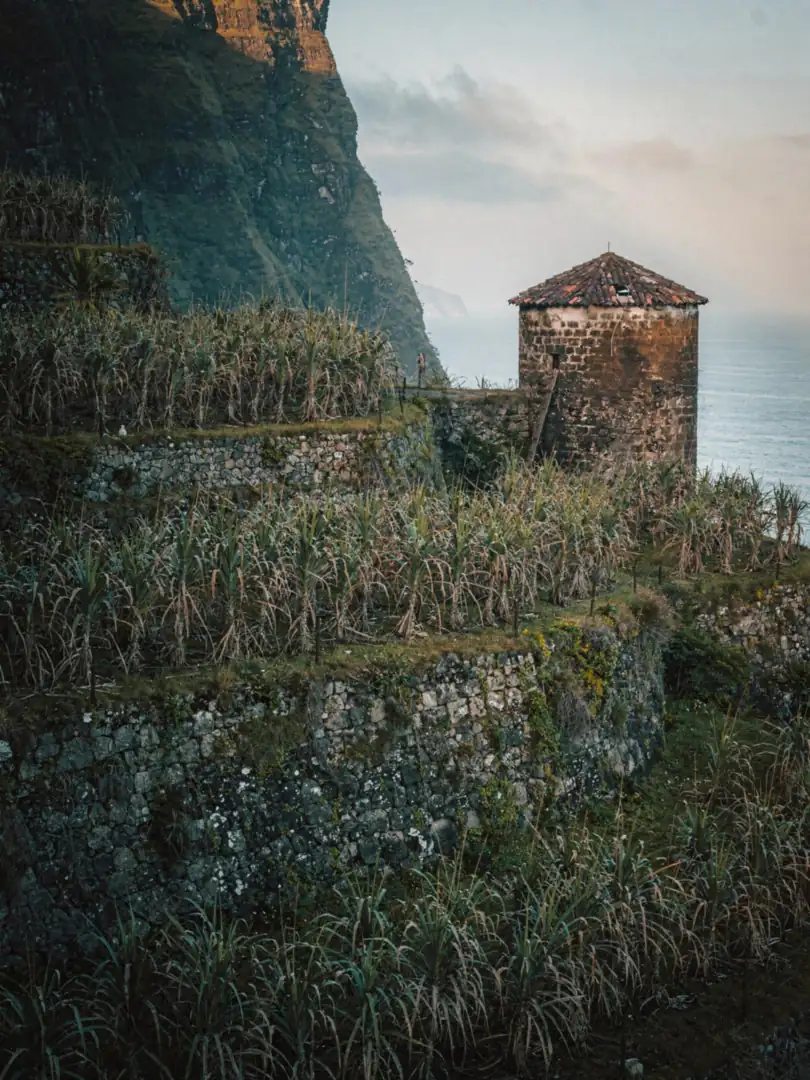
Under Henry the Navigator, the Portuguese brought cuttings from Sicily to Madeira around 1425. The island had what the cane needed: warmth, water from the mountains, and fertile volcanic soil. Farmers built terraces on the steep slopes, still called poios today. By the end of the 15th century, Madeira had become one of Europe's most important sugar suppliers, and sugar slowly shed its reputation as medicine.
On Madeira, and later on the Canaries and São Tomé, a pattern emerged that the Caribbean would later adopt: large plantations, mills, boiling houses, and forced labor. Madeira still matters for rum today. Rum da Madeira is a protected geographical indication of the EU and must be made from the juice of cane grown on the island.
Columbus in 1493 and the Caribbean's first sugar mills
On his second voyage in 1493, Christopher Columbus brought sugar cane across the Atlantic, according to the common account, cuttings from the Canary Islands. The cane took root on Hispaniola. Commercial sugar production was underway there by around 1520. Portugal built large sugar plantations in Brazil at almost the same time. Historian Câmara Cascudo dates the first cachaça there to 1532, though the written evidence for this is considered weak.
English and French settlers followed in the 17th century. On Martinique, sugar cane was growing by around 1640; on Barbados, it displaced tobacco and cotton in the 1640s. It was there that the sugar cane spirit first appeared under the name we know today: rum became known in the 17th century on Barbados, where a planter wrote of rumbullion in 1651.
That the cane thrived so well specifically in the Caribbean has to do with the climate. The islands lie within the trade wind belt. A rainy season makes the stalks grow quickly, while a drier season lets them store sugar. Volcanic soils, as on Martinique, and coral limestone, as on Barbados, offered different but equally fertile foundations. Add to that the coastal location: sugar, molasses, and later rum could be shipped directly from the coast to Europe and North America.
Why sugar and rum belong together
In the Caribbean, sugar cane was grown and processed on plantations by enslaved people. Without this forced labor, the sugar economy of the islands could never have reached such a scale. The journey through the history of rum covers the Atlantic trade and its consequences in detail. Here, the focus is the connection to the raw material.
Wherever sugar was boiled, molasses remained: a dark, viscous syrup that no longer crystallized. Together with foam and waste from the boiling houses, it could be fermented and distilled. In this way, a waste product became a trade good. The journey of sugar cane explains why rum emerged almost everywhere that sugar was made, and why most rums today are still made from molasses.