Eight plus Voltis
Which grape varieties are permitted in Champagne?
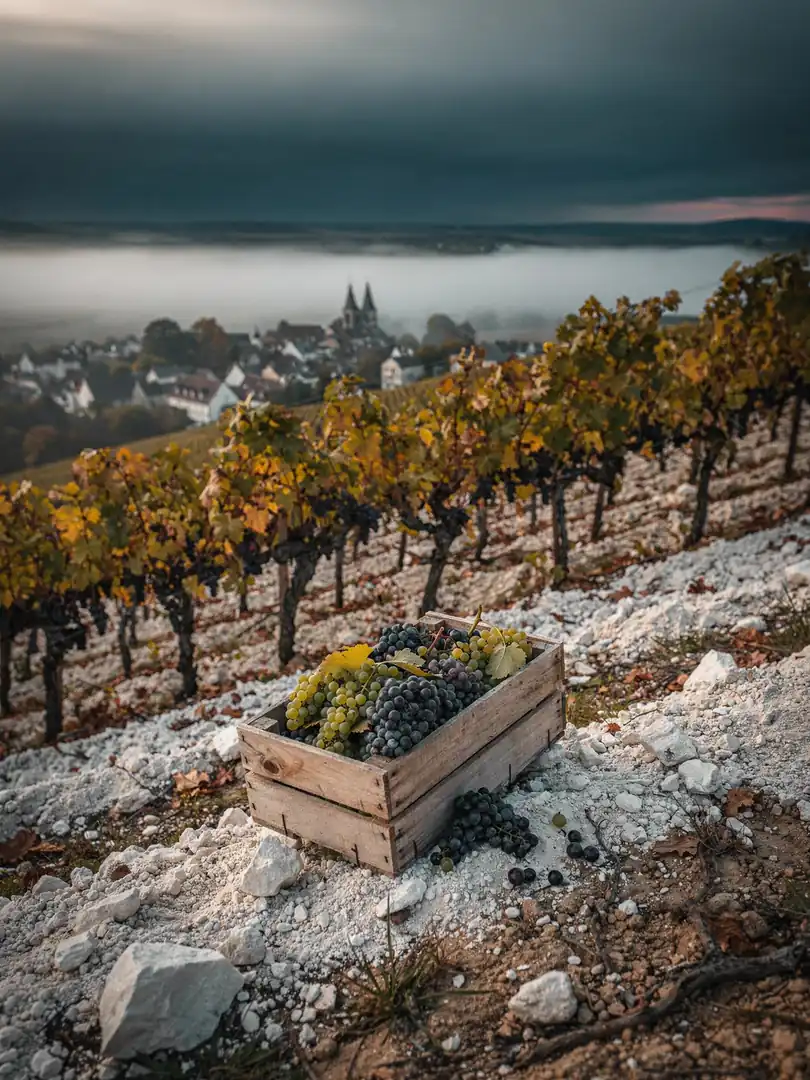
Eight grape varieties are permitted in Champagne: Chardonnay, Pinot Noir, Meunier, Pinot Blanc, Pinot Gris, Arbane, Petit Meslier, and Chardonnay rose. Since 2022, the newly bred Voltis has been added in small quantities. In practice, three varieties account for almost the entire harvest.
Which grape varieties does Champagne's appellation law permit?
Anyone who buys Champagne is almost always holding a blend of three grapes. The appellation's rulebook, known as the Cahier des charges, is more generous and lists eight main varieties. Alongside Chardonnay, Pinot Noir and Meunier, these are Pinot Blanc, Pinot Gris, Arbane, Petit Meslier, and Chardonnay rose, a variant of Chardonnay with pink-skinned berries. All other grapes are excluded. A Champagne made from Riesling or Sauvignon Blanc simply cannot exist, no matter how well it might be made.
This list applies to every bottle, from a simple Brut to a prestige cuvée. However, it does not regulate the proportions in which the varieties are blended. A house may make a Champagne from a single variety or from all eight. Since 2022, Voltis, a fungus-resistant new variety, has had its own separate list; it may only be used in small amounts and never on its own. The station on rare sparkling wine varieties explains this grape's origin and rules.
Why do Chardonnay, Pinot Noir and Meunier dominate?
On paper there are eight varieties, but in the vineyard there are barely three. Just under four in ten vines are Pinot Noir, with Meunier and Chardonnay splitting the rest almost evenly. According to the Champagne Bureau, the four old varieties—Arbane, Petit Meslier, Pinot Blanc and Pinot Gris—together account for less than 0.3 percent of the planted area.
The reason lies in the vineyard. When phylloxera, a vine pest introduced from America, devastated Europe's vineyards toward the end of the 19th century, growers rebuilding their vineyards favored varieties that cropped reliably. Arbane and Petit Meslier ripen late and unevenly and yield little. Chardonnay, Pinot Noir and Meunier, by contrast, reliably deliver what a base wine for sparkling wine needs in the cool north of France: plenty of acidity, moderate sugar, and an aroma that doesn't push to the fore beneath the yeasty notes.
What each variety contributes to the Champagne cuvée
Hardly any non-vintage Champagne is made from a single variety. The cellar master assembles the cuvée from many base wines, and each variety plays its own role. Chardonnay contributes acidity, citrus notes and finesse; it matures slowly and ages well. Pinot Noir gives body, structure and a hint of red fruit, even though its juice is pressed off white. Meunier contributes fruitiness and roundness, making a young Champagne more approachable sooner.
This interplay explains the various house styles. A blend high in Chardonnay feels leaner and tauter, while one with a high proportion of Pinot Noir is fuller and broader. Producers who use more Meunier lean toward fruit and charm. Stating the grape varieties is not mandatory for Champagne, but many producers list them on the back label or in the technical data sheet anyway. Champagnes made purely from Chardonnay or Pinot carry their own names: Blanc de Blancs and Blanc de Noirs. The thematic journey on Champagne explains what defines these styles.
Grape varieties compared: Champagne, Crémant, Sekt and Cava
A fixed list of varieties is a hallmark of the origin, not of the method. Traditional bottle fermentation—the second fermentation that takes place in the very bottle the wine is later sold in—works with any grape. Crémant appellations therefore each have their own varieties: in Alsace, Pinot Blanc and Riesling are grown among others, while in the Loire, Chenin Blanc often defines Crémant. Cava relies on Macabeo, Xarel·lo and Parellada, Prosecco on at least 85 percent Glera.
The German-speaking world is the most liberal. There are no mandatory varieties for Sekt b.A. from Germany or for Austrian Sekt g.U.; anything permitted as quality wine in the respective region is allowed. A German Sekt can therefore be made from Chardonnay and Spätburgunder and come very close to Champagne. A Champagne, conversely, can never taste like Riesling. Anyone wanting to understand why two bottle-fermented sparkling wines can turn out so differently should therefore look first at the grape and only then at the method.