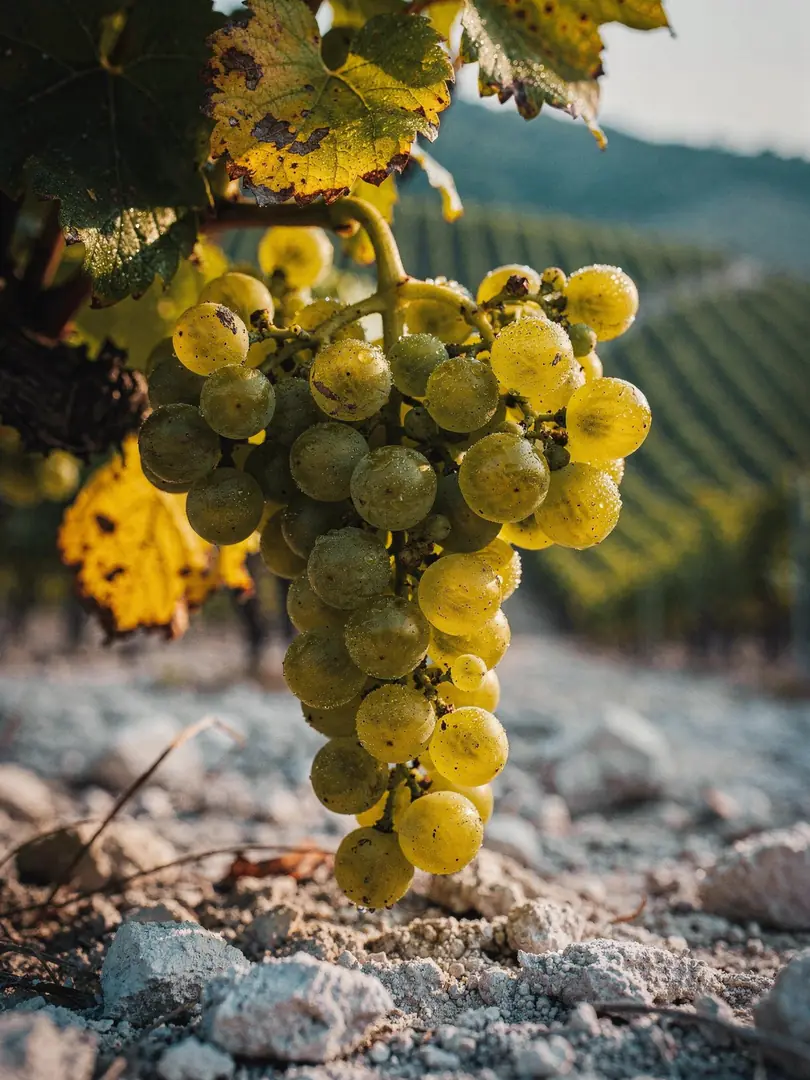
Acidity, chalk, maturity
Chardonnay in sparkling wine
Chardonnay is one of the world's most important sparkling wine grapes because, picked early, it retains plenty of acidity, has a restrained inherent aroma, and can age on the lees for a long time. It is found in Champagne, Franciacorta, Trentodoc, Crémant de Bourgogne, English sparkling wine, and many Sekts.
Why is Chardonnay so well suited to sparkling wine?
For a still wine, Chardonnay is often left hanging for a long time until it is ripe and full-bodied. For sparkling wine, it is picked considerably earlier. At that stage the berry has little sugar and plenty of acidity, which is exactly what a base wine needs. It shouldn't be too high in alcohol, since the second fermentation in bottle or tank adds a bit more. A Chardonnay that would taste thin and tart as a still wine is often just right for sparkling wine.
The second advantage is restraint. Young Chardonnay smells of lemon, green apple and white blossom without ever becoming loud. This leaves room for the aromas that develop during extended contact with the lees. Cellar workers call this autolysis, the slow breakdown of yeast cells, which produces notes of brioche and toast. A strongly aromatic grape would mask this note; Chardonnay carries it instead. There's also its longevity: its acidity keeps sparkling wines fresh for many years.
Chardonnay in Champagne: the Côte des Blancs
The best-known Chardonnay landscape for sparkling wine lies south of Épernay. The Côte des Blancs, literally the hillside of the whites, is planted almost entirely with Chardonnay. Beneath a thin layer of topsoil lies chalk, a soft, porous limestone that stores water and sustains the roots even in dry summers. The villages of Avize, Cramant, Le Mesnil-sur-Oger, Oger, Chouilly and Oiry are classified as Grand Cru.
Chardonnay from this chalk is considered particularly taut, with a saline-tasting finish. Houses use it as the backbone of their cuvées because it lends length and freshness to the blend. When a producer bottles it alone, the result is a Blanc de Blancs, literally a white from white grapes. The Champagne region also permits Chardonnay rose, a variant with pink-skinned berries that is rarely planted. For the sparkling wine, the skin color makes little difference, since the juice picks up almost no color during the quick pressing.
Chardonnay sparkling wine from Italy, France and England
Outside Champagne, Chardonnay appears in almost every origin that relies on bottle fermentation. In Franciacorta on Lake Iseo, it forms the base together with Pinot Nero; Pinot Bianco may make up at most half, and the old variety Erbamat at most a tenth. The Satèn from this appellation is made only from white grapes and has lower pressure. In Trentino, Chardonnay benefits from mountain sites with cool nights. In Piedmont, Alta Langa requires it alongside Pinot Nero and at least 30 months of lees aging.
In Burgundy, the variety's homeland, Chardonnay is the main pillar of Crémant de Bourgogne. In Cava, by contrast, it covers only 6.7 percent of the vineyard area (2025), because native varieties set the tone there. In England, Chardonnay is the most widely planted grape variety overall, and southern English sparkling wines follow the Champagne model. In Germany, Sekt producers in regions such as the Pfalz and Baden use Chardonnay, often together with Spätburgunder.
How does Chardonnay taste in sparkling wine, young and aged?
A young Chardonnay sparkling wine after a short lees aging feels bright and lively. The nose shows citrus fruit, green apple and sometimes pear, the palate has noticeable acidity and a fine, quickly rising mousse. If the same wine stays on the lees for three or four years, the picture shifts. The fruit recedes, and notes of nuts, fresh bread and butter biscuit emerge, while the carbonation feels creamier.
After disgorgement, the removal of the lees, a Chardonnay sparkling wine continues to develop in the bottle. After years, some can recall roasted hazelnut, honey and dried fruit, while the acidity keeps everything taut. Other varieties age faster or lose their freshness sooner. This becomes clear when comparing two sparkling wines from the same producer with different lengths of lees aging. The thematic journey on storing and aging explains how to keep such bottles.