Red varieties pressed off white
Pinot Noir and Meunier: red grapes for white sparkling wine
White sparkling wine is made from red grapes because the pigment sits almost entirely in the grape skin. When Pinot Noir and Meunier are pressed whole and gently, the juice runs off nearly colorless. These two varieties cover just over two-thirds of Champagne's planted area and give the sparkling wine body and fruit.
How does white sparkling wine come from red grapes?
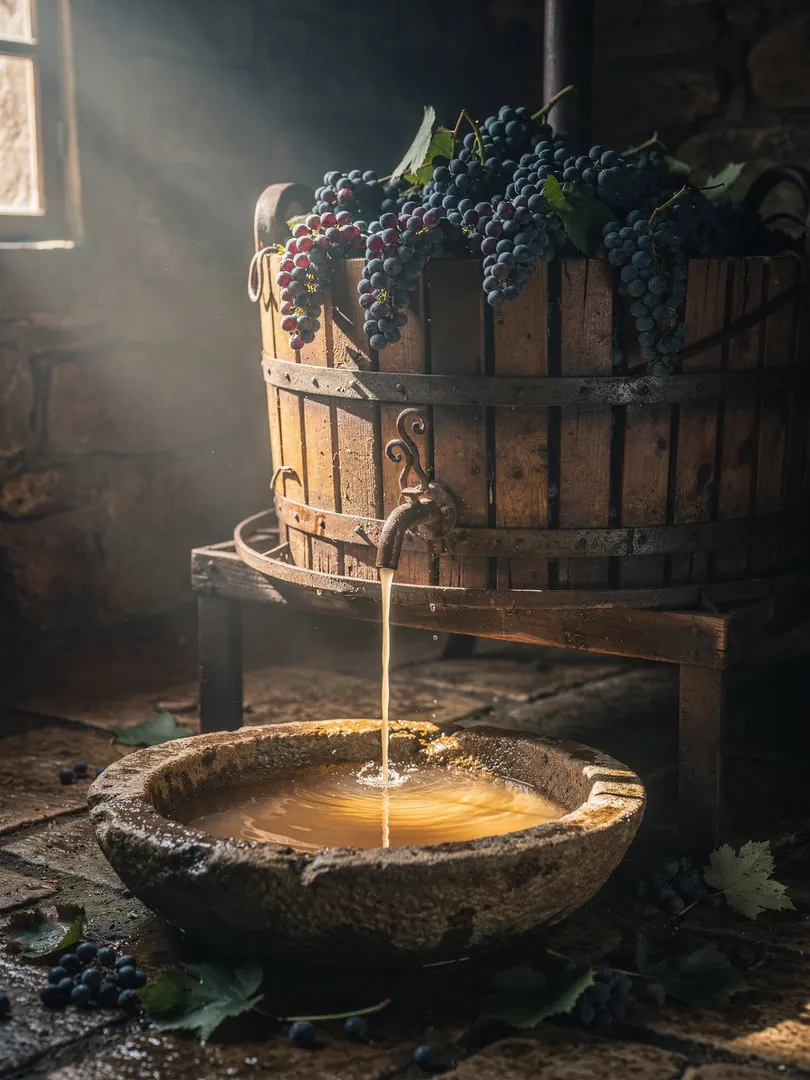
Cut open a Pinot Noir berry and the flesh is pale green. The color lies in pigments in the skin, the anthocyanins, and they only pass into the juice once skin and must have had extended contact. For red wine, the must—the mixture of crushed berries and juice—is therefore left to ferment on the skins for days. For sparkling wine, the opposite happens: the grapes go into the press whole and are pressed quickly and with little pressure.
The juice that runs off first is almost colorless and has the finest acidity. Later pressing fractions pick up more color and tannin; in Champagne these are vinified separately. A faint hint of salmon or copper can still remain. German wine law permits the designation Blanc de Noirs for Sekt as well, provided the wine was made from red grapes vinified like a white wine and has a color typical of white wine.
Pinot Noir in sparkling wine: structure and red fruit
Pinot Noir, called Spätburgunder in Germany and Pinot Nero in Italy, is the variety with the most weight. It gives sparkling wine body, firm structure and a long finish, along with notes of red berries, cherry and sometimes forest floor. In Champagne it grows mainly on the Montagne de Reims, with Grand Cru villages such as Ambonnay, Bouzy, Verzenay and Verzy. In the south, it defines the Côte des Bar in the Aube département.
Pinot Noir is also the variety used for rosé. Many rosé Champagnes are made by adding a little red wine from Pinot Noir to the white base wine before the second fermentation. This is permitted for sparkling wine, though banned for still wine in the EU. The variety is needed for this purpose outside France too: Franciacorta Rosé requires at least 35 percent Pinot Nero, while Prosecco DOC Rosé contains 10 to 15 percent. For Oltrepò Pavese Metodo Classico from Lombardy, Pinot Nero must even make up at least 70 percent of every cuvée.
Meunier: the Müllerrebe from the Marne Valley
Meunier means miller in French. The variety owes its name to the fine white hairs on the underside of the leaf, which look as if someone had dusted them with flour. In Germany it is known as Schwarzriesling or Müllerrebe, grown mainly in Württemberg. In Champagne it was long called Pinot Meunier; today the rulebook lists it simply as Meunier.
Its advantage lies in the calendar. Meunier buds later than Pinot Noir and Chardonnay, which often lets it escape spring frosts. This makes it the variety of choice for the cooler, frost-prone sites of the Vallée de la Marne and the more clay-rich soils west of Épernay. For a long time, Meunier was regarded as the workhorse behind young, early-drinking Champagnes. Today, some growers bottle it as a single variety, showing it can also develop depth with age. Meunier is permitted in Trentodoc as well.
Pinot Noir or Meunier: what's the difference in the glass?
In a direct comparison, Pinot Noir feels more serious and taut. It needs time on the lees and in the bottle before its structure unfolds, which suits it to long-aged cuvées. Meunier is more open. It smells of ripe apple, yellow plum and sometimes bread crust, tastes rounder, and is approachable sooner.
For the cuvée, this means: Pinot Noir provides the framework, Meunier the fruit. A Blanc de Noirs can be made from either variety or from both, and the label rarely reveals which predominates. In Germany, a Blanc de Noirs Sekt is usually made from Spätburgunder, occasionally from Schwarzriesling. Anyone wanting the exact details will often find the varieties on the back label or in the producer's technical data sheet. That sheet will also state whether a rosé came from blending in red wine or from brief skin contact.