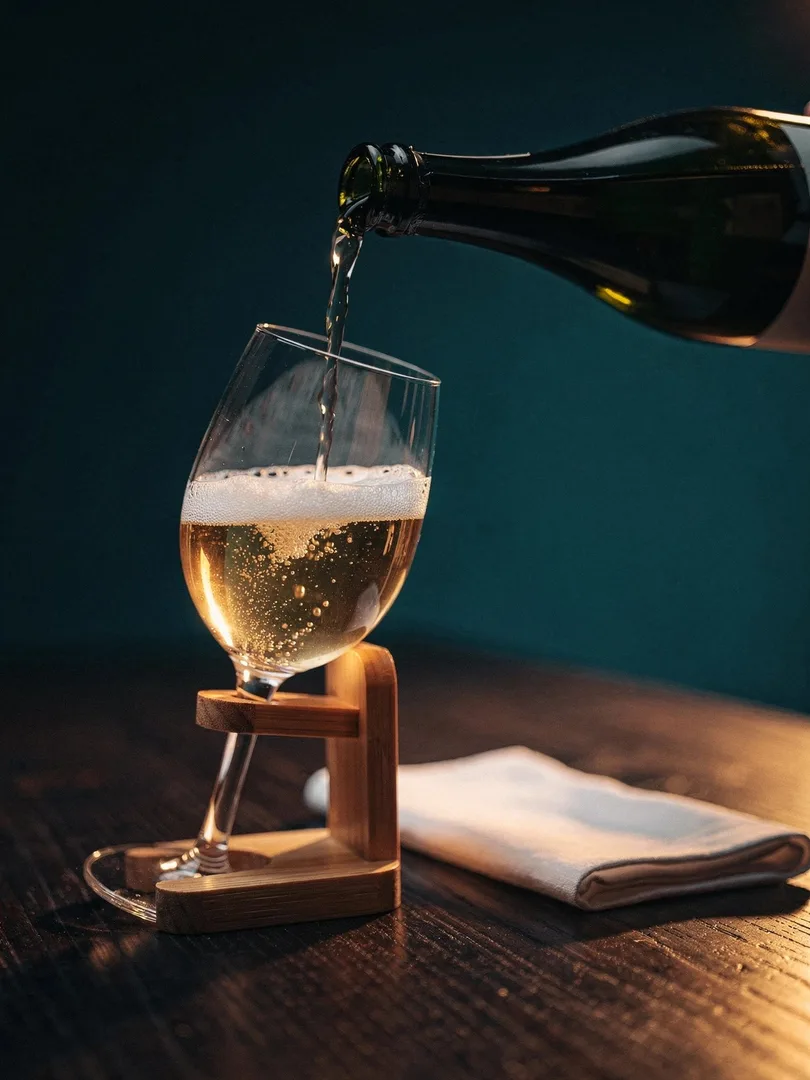
At an angle, and twice
Pouring Champagne correctly
Sparkling wine is poured in two steps: first a small splash into the glass held at a slight angle, letting the foam settle, then slowly topping up along the glass rim to about half or two-thirds full. This way, most of the carbonation stays in the wine, as researchers in Reims have measured.
Why pour at an angle? What the research in Reims showed
When pouring, sparkling wine loses more carbon dioxide than it does in the minutes afterward in the glass. The stream churns up the wine, pulls in air, and creates foam. Every bubble in that foam is gas that has already left the wine. That's why pouring high and straight down into the center of the glass causes especially large losses.
Gérard Liger-Belair and his team at the University of Reims demonstrated this in 2010 in the Journal of Agricultural and Food Chemistry. They compared two methods. In one, the glass stands upright and the Champagne falls into it. In the other, the glass is held at an angle, the wine runs down the side, and the glass is gradually straightened as it fills, the way beer is poured from a tap. The angled method retained significantly more dissolved carbon dioxide in the glass—according to the American Chemical Society's report, up to twice as much.
How full should you pour sparkling wine?
A sparkling wine glass is never filled to the brim. The rule of thumb is half to two-thirds full, or even less for large white wine glasses. The empty space above the wine isn't stinginess—it's where the aroma collects. A full glass is also hard to swirl and will overflow when glasses clink.
Small pours have another advantage: the wine stays cold because it's drunk quickly while the bottle waits in the cooler in between. That's why, when serving at the table, everyone gets a small splash first. Once the foam has settled in all the glasses, you go around a second time to top them off. This way, everyone gets their glass at the same time, and none overflows.
In the hospitality industry, a standard pour for sparkling wine is about 0.1 liters (roughly 3.4 fl oz). A standard 0.75-liter bottle thus yields seven glasses, or six with a slightly more generous pour. This makes it easy to plan how many bottles should be chilled and ready for a reception. At home, nobody needs to measure exactly, but knowing this standard helps develop a feel for the right amount, so the first glass isn't overly generous while the last is nearly empty.
Holding the bottle and pouring: table-side service
Professionally, the bottle is held at the base. The thumb rests in the indentation that experts call the punt or kick, while the fingers support the body of the bottle. The label faces the guest. This grip looks elegant, but it requires a steady hand. If you're unsure, holding the bottle further up by the body is perfectly fine.
The mouth of the bottle shouldn't touch the glass. After each pour, the bottle is given a slight twist so the last drop stays at the neck, caught by a cloth. In a restaurant, the host tastes a small sip first—not for flavor preference, but to check for faults like cork taint. Large formats like the Magnum are poured with both hands, slowly and with small pauses.
Foams too much: common pouring mistakes
If sparkling wine shoots up in the glass immediately, the wine is almost always too warm or the glass was filled too quickly. Glasses fresh out of the dishwasher and still warm are another common culprit. A stream poured from too great a height also creates excess foam. Keeping the first pour small and giving the foam time to settle solves most problems by the second glass.
Sparkling wines with lees still in the bottle require special handling. Pét-Nat and Prosecco Sui Lieviti often have a fine sediment. If you want a clear wine, stand the bottle upright beforehand and pour calmly in one steady motion, without tilting it back upright in between. The last bit will remain cloudy in the bottle. Some people actually prefer that final sip—it tastes yeastier and fuller.