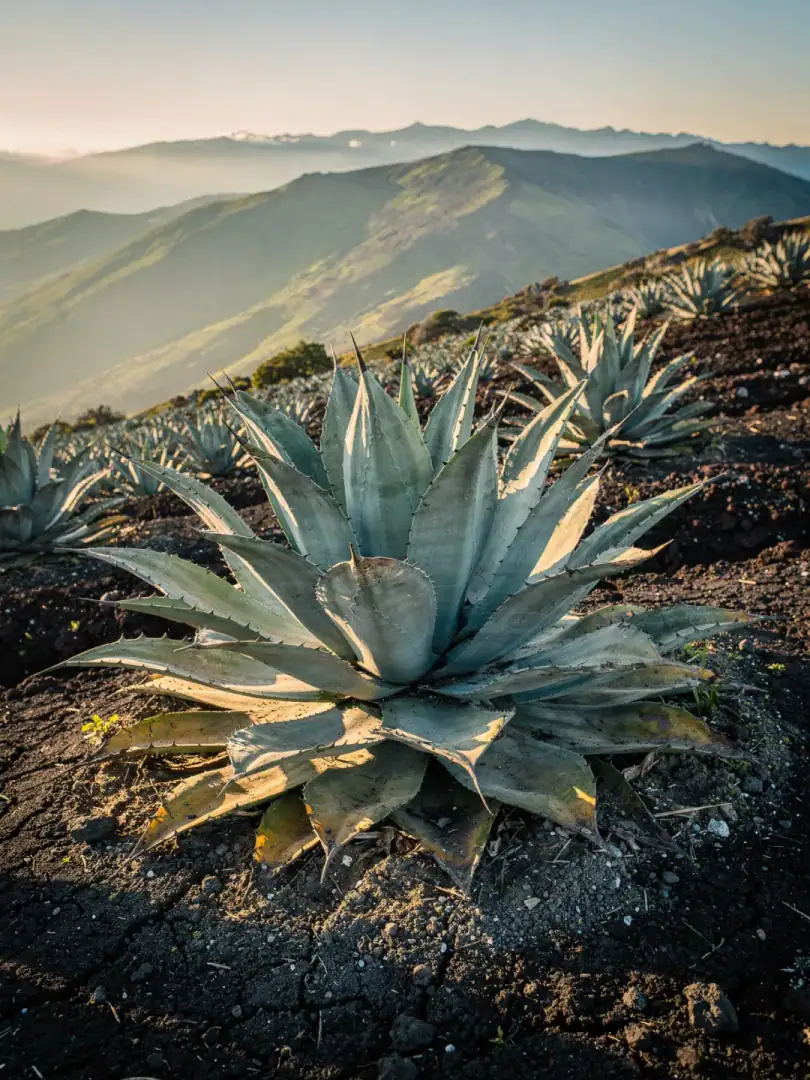
Tzawar on Volcanic Ash
Agave & Soil
Walking along the field edges in the valleys around Cayambe or Cotopaxi, you often see them before you even look. Rows of gray-green agave have stood for generations as living fences between plots. This is Agave americana, called Tzawar in Kichwa and Penco in Spanish, the primary plant used for Miske.
Growing alongside it, more rarely and usually higher up the slopes, is Agave cordillerensis. This wild relative thrives in drier spots near the páramo. Both species yield the juice from which Miske is made. But Penco accounts for the bulk of the harvest. It has been deliberately planted along field edges for centuries and needs no searching out.
It takes between eight and 25 years for a plant to mature enough for harvest. In practice, it's usually twelve to fifteen. Harvesters recognize the right moment not by a calendar but by the plant itself. The leaves grow wider and lie flatter, snapping with a crack when pressed together. The color shifts toward whitish, and the base turns yellow. At the same time, the central shoot, from which the flower stalk would otherwise grow, shrinks.
This is exactly where the similarity to Tequila or Mezcal ends. There's no jimador hacking the piña out of the ground with a coa. The agave stays rooted and alive. Only its heart is hollowed out, allowing the juice to collect there over weeks. Harvesting takes place mainly between July and September, during the dry season, since rain would dilute the collected juice and cause it to spoil.
Beneath these fields lies volcanic soil, dark and light in texture, built up from thousands of years of ash from the surrounding volcanoes. It retains water well. Deeper down, however, a hard layer called cangahua limits root growth, as roots can barely penetrate it. This forces the agave to spread its roots wide and shallow, just enough to survive for decades, but not much more.
Loose, dark volcanic ash, rich in organic matter from centuries of leaf litter.
The root: Here the agave finds its nutrients and most of its water after rainfall.