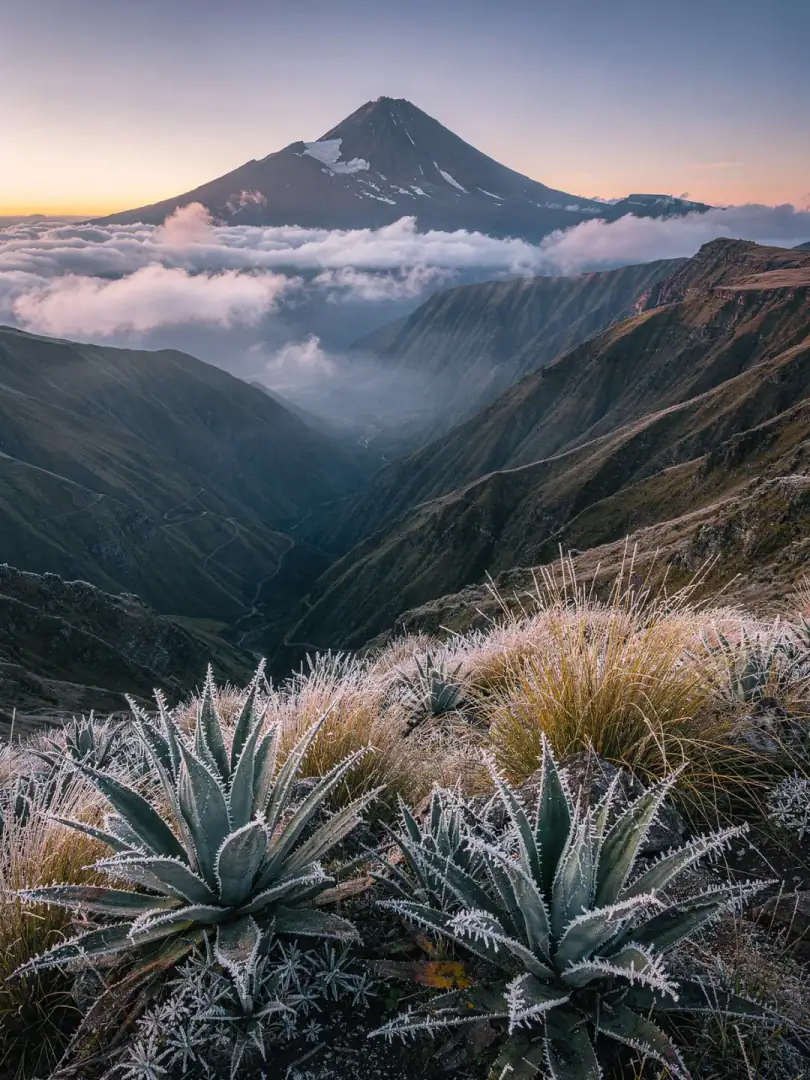
Nights Full of Cold
Altitude & Climate
The fields where Tzawar grows for Miske lie between 1,800 and 3,000 meters. They stretch from the mild valleys around Cayambe to the edge of the páramo near Chimborazo and Cotopaxi, where vegetation grows sparser.
Because the equator is so close, temperatures barely change over the course of the year. What does change is the day itself. At noon, the sun burns fiercely through the thin air, while at night temperatures often drop close to freezing. This is especially true at higher elevations near the páramo. For the agave, this means a constant swing between heat and cold, decade after decade.
Two dry seasons and two rainy seasons alternate each year in the Ecuadorian highlands. Between July and September, when rain falls least often, families harvest the juice. Moisture from outside would dilute it and cause it to spoil faster before it ever reaches the fermentation vat.
All these extremes have an effect on the sap. Because the agave grows slowly over twelve to fifteen years, it accumulates its sugars over a very long time. Cold, altitude, and intense equatorial sunlight concentrate this sugar even further. The result is a Tzawarmishky that is sweeter and more aromatic from the very start. Faster-growing plants at lower elevations, by contrast, yield a milder sap.
Frost is no rarity at the upper edge of the growing zone, especially on clear-sky nights. Cloudless nights let the day's warmth escape unhindered. That's no different at 3,000 meters on the equator than anywhere else in the Andes. Harvesters therefore often work early in the morning or late in the afternoon, when the midday sun no longer beats down directly on the fields.