Sap Instead of Fire
Cooking & Milling
No fire, no oven, no pit. At this stage of production, something happens with Miske that would be the exception for any other agave spirit: nothing. While the autoclave steams in Jalisco and the earthen pit smolders in Oaxaca, the Tzawar in Ecuador stays cool and whole.
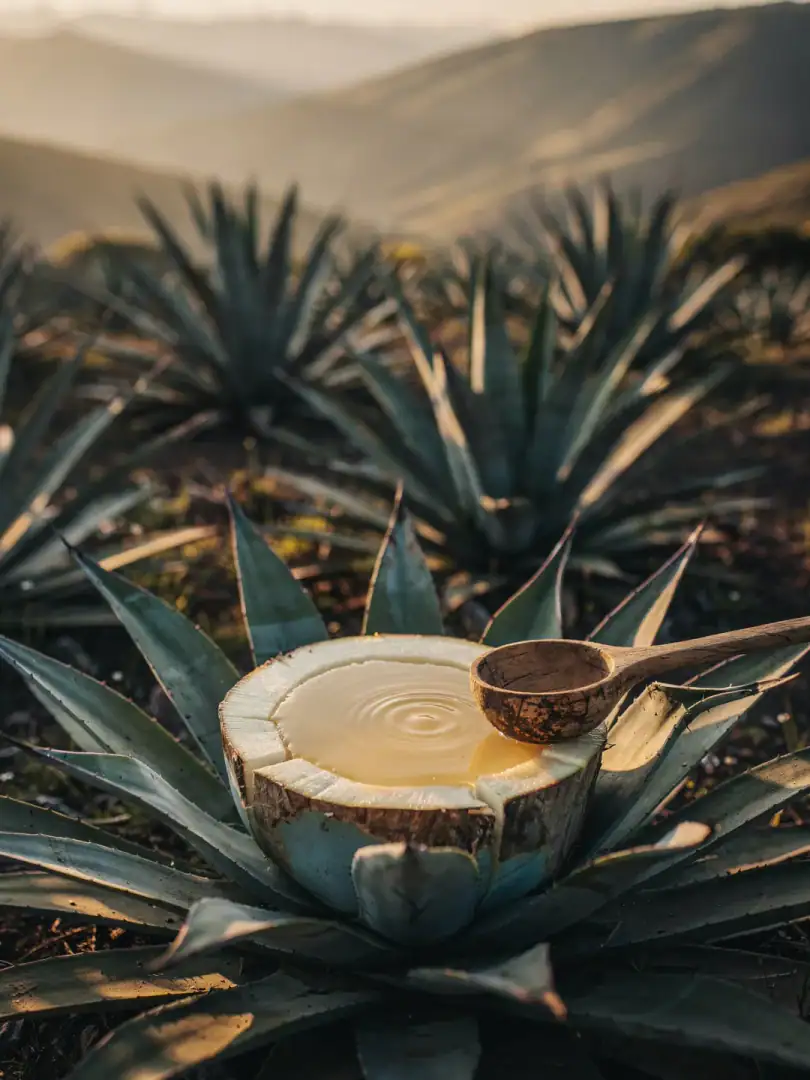
Instead of harvesting the piña, the harvester hollows out the heart of the living penco, shaping a basin within it. Over the following weeks, Tzawarmishky collects there. The agave draws it from its own leaves, just as it would naturally do shortly before flowering. Several times a day, the basin is emptied with a ladle until the plant is exhausted and dies.
The reason nothing needs to be cooked here lies in the plant itself. Agaves store their sugar for years as a carbohydrate called inulin. Only shortly before flowering do they convert it into fermentable sugar, to gather enough energy for the flowering stalk. Tequila and mezcal producers must force this step artificially in an oven, because they harvest the piña years before flowering. With Miske, the plant does this work itself, in the final years of its life.
For the same reason, the second step familiar from tequila production is also absent. There is no tahona, no mill, no wooden mallet crushing fibers. The collected sap is already liquid and sugar-rich; no one needs to press it out of cooked fibrous material. What takes hours of mash work for tequila and mezcal is replaced here by a ladle and a little patience.
This omission means more than just a difference in craft. Whoever roasts the piña in an oven or autoclave afterward distills tequila or mezcal, never Miske. Whoever draws the raw sap from the hollowed-out, living plant, ferments it, and distills it, may call it Miske. No other name is permitted. At this stage, the three drinks diverge most clearly.