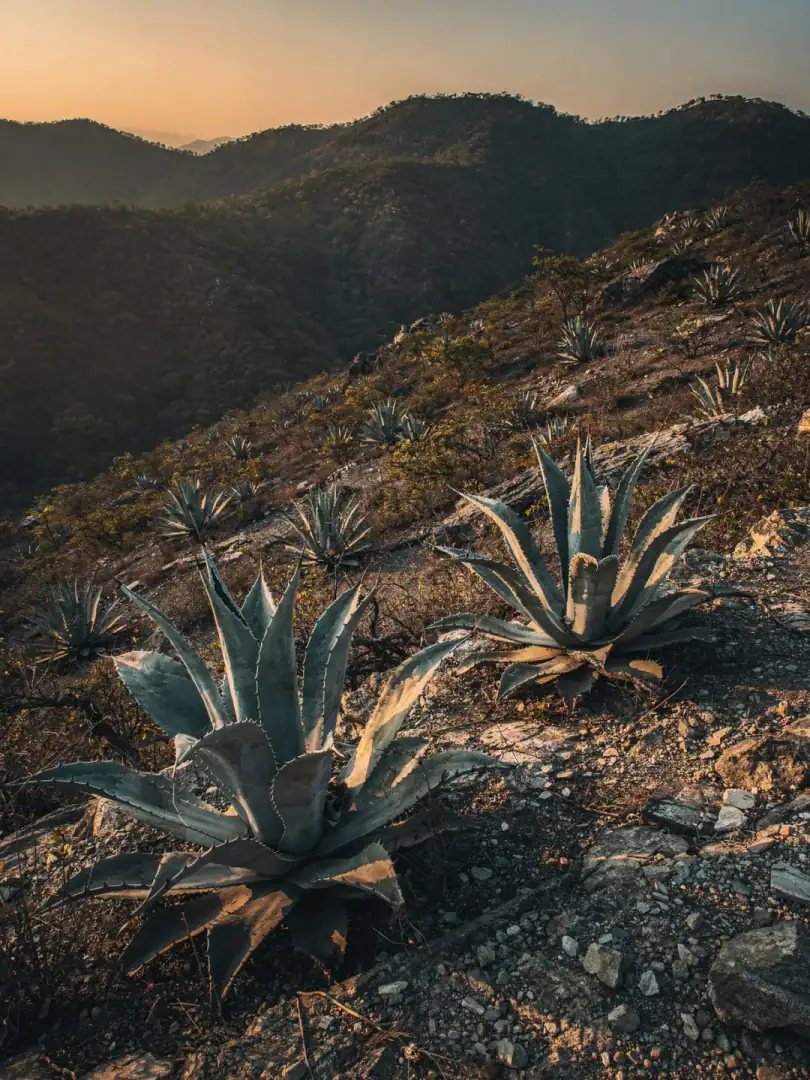
Wild Papalote Agave
Agave & Soil
In the mountains around Chilapa de Álvarez grows the agave from which Guerrero distills its mezcal. Botanically named Agave cupreata, it's known locally as Papalote or Maguey Papalote. It thrives in the Sierra Madre del Sur, between 1,200 and 1,800 meters in elevation, on stony, lean soil where few other crops can survive.
Unlike the blue Weber agave used for tequila, Papalote isn't planted in neat rows. It self-seeds, scattered across steep slopes within the watershed of the Río Balsas, which spans Guerrero and neighboring Michoacán. Because deforestation and overharvesting are shrinking its habitat, the species is now considered endangered.
It takes 18 to 25 years for a Papalote agave to mature enough for the palenque, and up to 30 years in favorable locations. That's considerably longer than most cultivated agaves, and one reason why mezcal from this plant remains scarce and expensive.
Harvesting falls to the jimador, who wields the coa, a knife with a long handle and rounded blade. He trims away the spiny leaves until only the piña remains, the heart that will later be roasted in the oven. On steep slopes with no road access, jimadores often carry the piñas in nets to the nearest road.
Because the Papalote agave grows wild and matures slowly, Guerrero's mezcal depends directly on the health of the forest. Collectives like Sanzekan Tinemi reforest rather than clear new land, safeguarding the supply for generations to come.
A thin, humus-poor layer between loose rock and bare stone.
The root: The agave anchors itself shallowly, absorbing rain immediately before it seeps away.