Stone Instead of Steel
Cooking & Milling
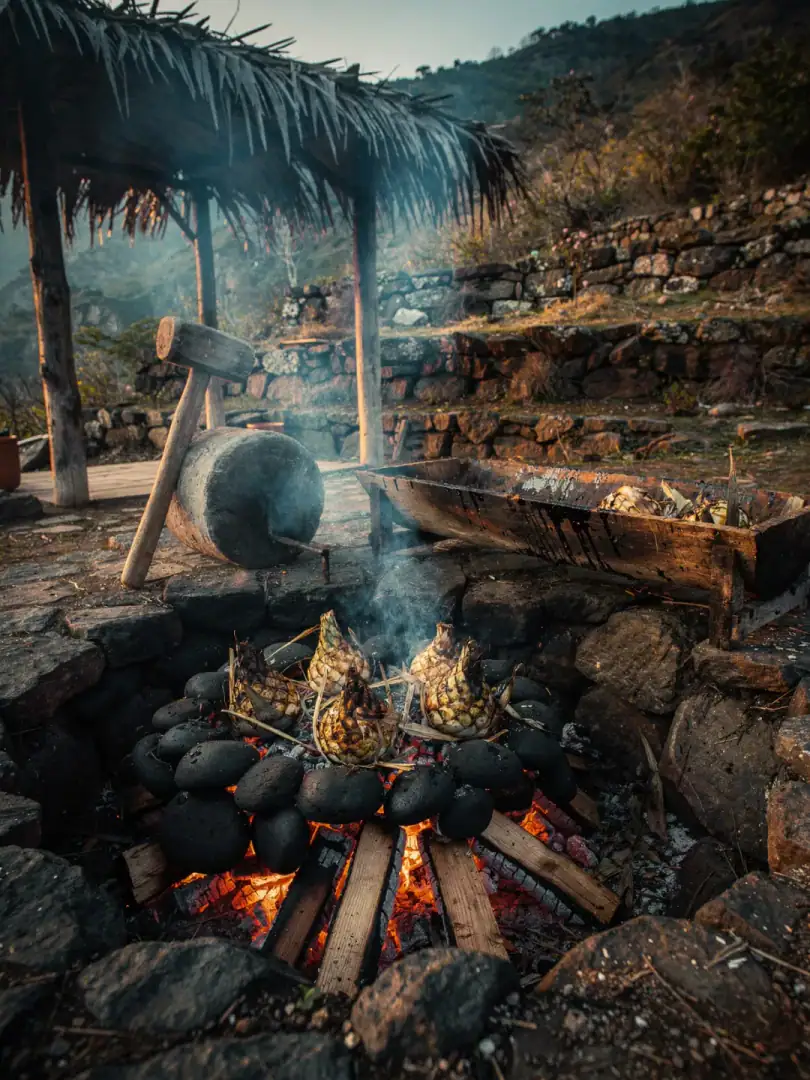
Before the piña becomes mezcal, it must first be roasted. In many palenques around Chilapa de Álvarez and Zitlala, this happens in ovens with stone floors. The peeled agave hearts go onto glowing stones, are fired with oak wood, and covered with earth and leaves until the sugar in the piña caramelizes.
This method falls under the category of Mezcal Artesanal as defined by standard NOM-070. Earthen pits or brick-lined ovens are permitted, while autoclaves and diffusers, reserved for industrial mezcal, are prohibited. Anyone in Guerrero who cooks with steam instead of fire may call the result "mezcal," but not "Artesanal" or "Ancestral."
After roasting, the piña is crushed, known locally as "martajado." Traditionally this is done using the tahona, a stone wheel pulled by animal or motor, or the mazo, a heavy wooden mallet wielded by hand. Both methods press the juice from the fibers without completely destroying them.
These fibers, called bagazo in Guerrero, often remain in the mash and travel along into the fermentation vat. This sets the artisanal process apart from industrial mezcal production, where the fibers are typically removed before fermentation.
How long a batch stays in the oven depends on the quantity and size of the piñas, often several days straight. Only afterward is the agave sweet enough to ferment, and the next step in the palenque can begin.
In Mochitlán, some operations have started using mechanical mills to process larger quantities. Others stick with the mazo, believing it treats the fibers more gently and imparts more strength from the wood into the mezcal.