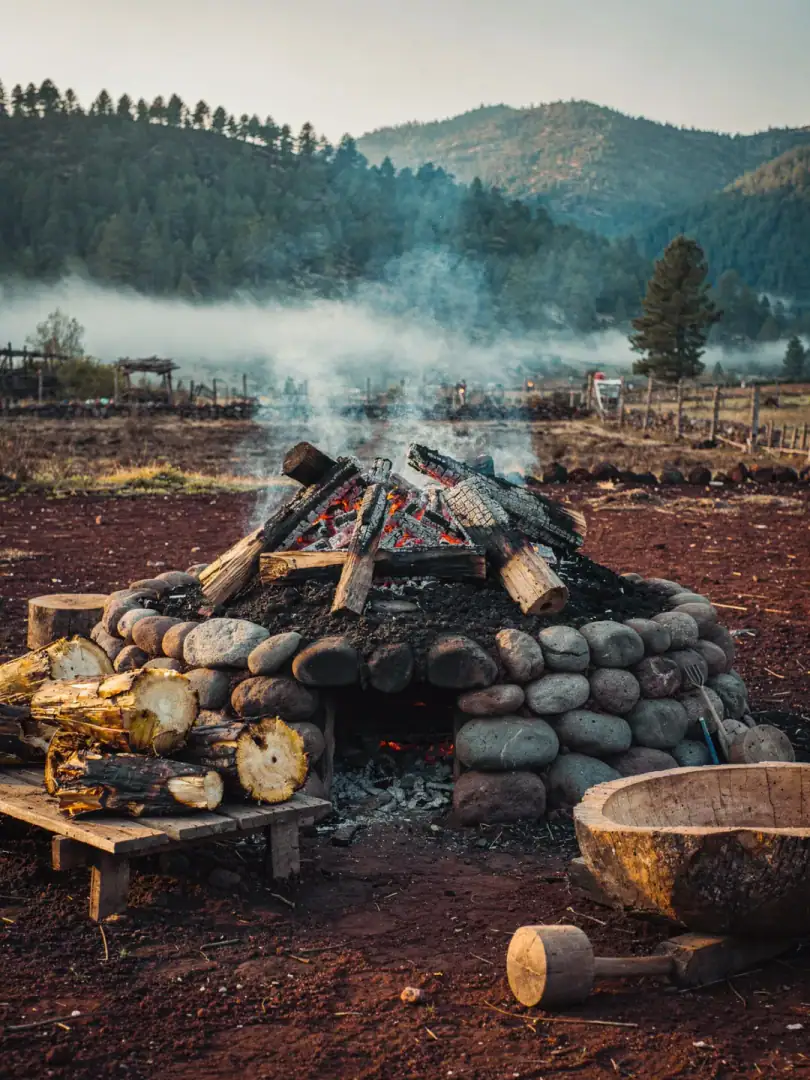
Earthen Pit and Mazo
Cooking & Milling
A pit lined with stones already waits outside the taberna in Tzitzio when the piñas arrive. What happens next determines the category of the finished mezcal far more than any marketing copy.
The halved or whole piñas go into a cone-shaped earthen pit oven, get covered with stones, and are slow-cooked for several days over encino, an oak species from the surrounding forests. The wood smoke penetrates deep into the agave flesh, giving the future mezcal its characteristic roasted note.
After cooking, the soft piñas are crushed by hand or with the mazo, a heavy wooden mallet, in a hollowed-out log canoa. Larger tabernas also use a stone tahona, pulled by a mule or a motor.
It's precisely this process—earthen pit plus hand labor or tahona—that classifies a mezcal as Artesanal under the NOM-070 standard. Anyone using an autoclave or diffuser instead can still call their distillate mezcal, but no longer Artesanal, and certainly not Ancestral. It could never become Tequila anyway, since both blue agave and Tequila territory are missing here.
Some tabernas mix in fibrous remnants from earlier batches to distribute the heat more evenly. Others swear by fresh encino wood for every batch, because otherwise too much smoky aroma builds up.
For the taberneros around Etúcuaro, this isn't a bureaucratic detail but confirmation of a process their families have passed down almost unchanged for generations.