Wild and Pacific
Agave & Soil
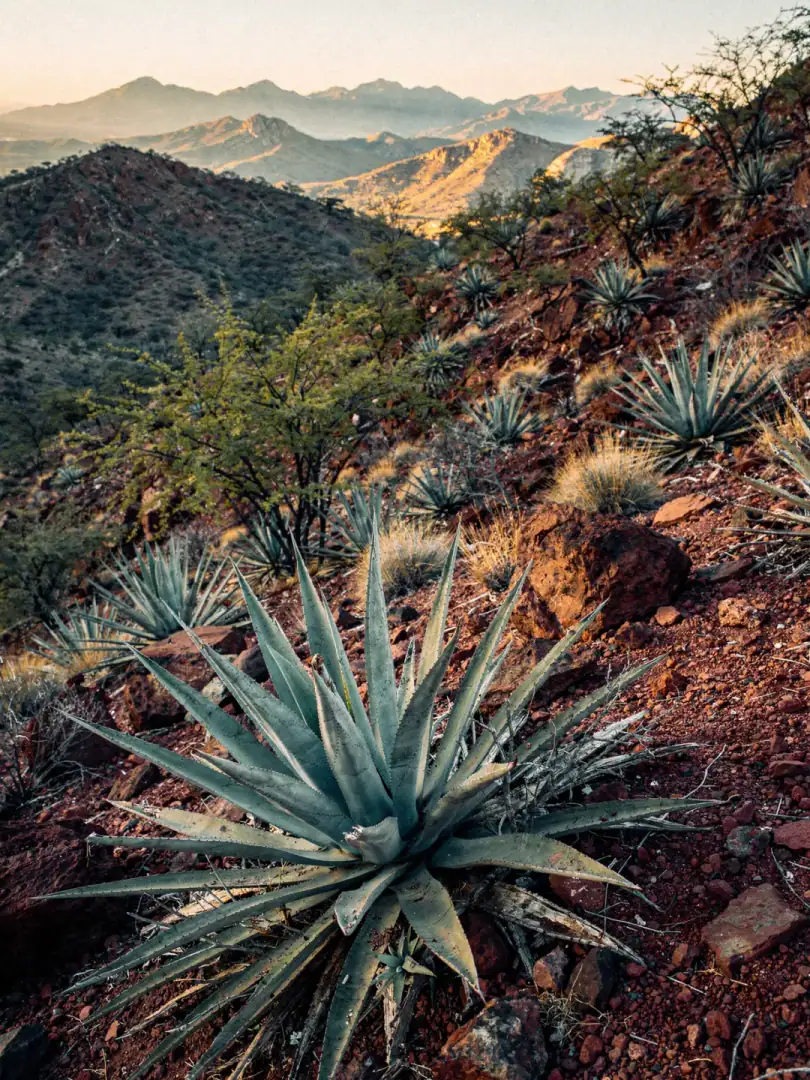
On the slopes below the Bacanora villages grows Agave angustifolia, botanically closely related to the Espadín of Oaxaca. In Sonora, locals usually call it yaquiana, after the pacifica variety. This agave grows wild here, in the dry forests of the Sierra.
With Bacanora, wild is almost the rule rather than the exception. Near the coast, where the mountains flatten out, the plants carry short, broad leaves. Higher up, in the steep terrain, the leaves grow narrower and longer, almost limp. This reflects the poorer soils and drier climate found there.
It takes between seven and twelve years for a wild agave to reach harvest maturity. Much depends on the soil and the rainfall. Cultivated plants from the fields around the villages grow faster with a bit of care. Maturity shows in the quiote, the flowering stalk. The jimador cuts this off in good time so the plant doesn't pour its sugar reserves into flowering.
With the coa, a kind of flat blade on a long handle, the jimador strips away the spiny leaves. What remains is only the piña, the heart of the agave. In the Sierra, such a piña often weighs less than the thick heads from Jalisco. The wild plant invests more in roots and leaves than in sugar reserves.
This very agave makes the difference from Tequila clear. Botanically it stands close to the Espadín variety, which is also used to distill inexpensive Mezcal. But it grows in Sonora and is processed under Bacanora law. That's why the finished spirit is called only Bacanora, and nothing else.
A thin layer of mesquite and oak leaves that holds almost no water.
The root: The agave draws almost nothing from it, since its roots lie deeper.