Earthen Pit and Mesquite
Cooking & Milling
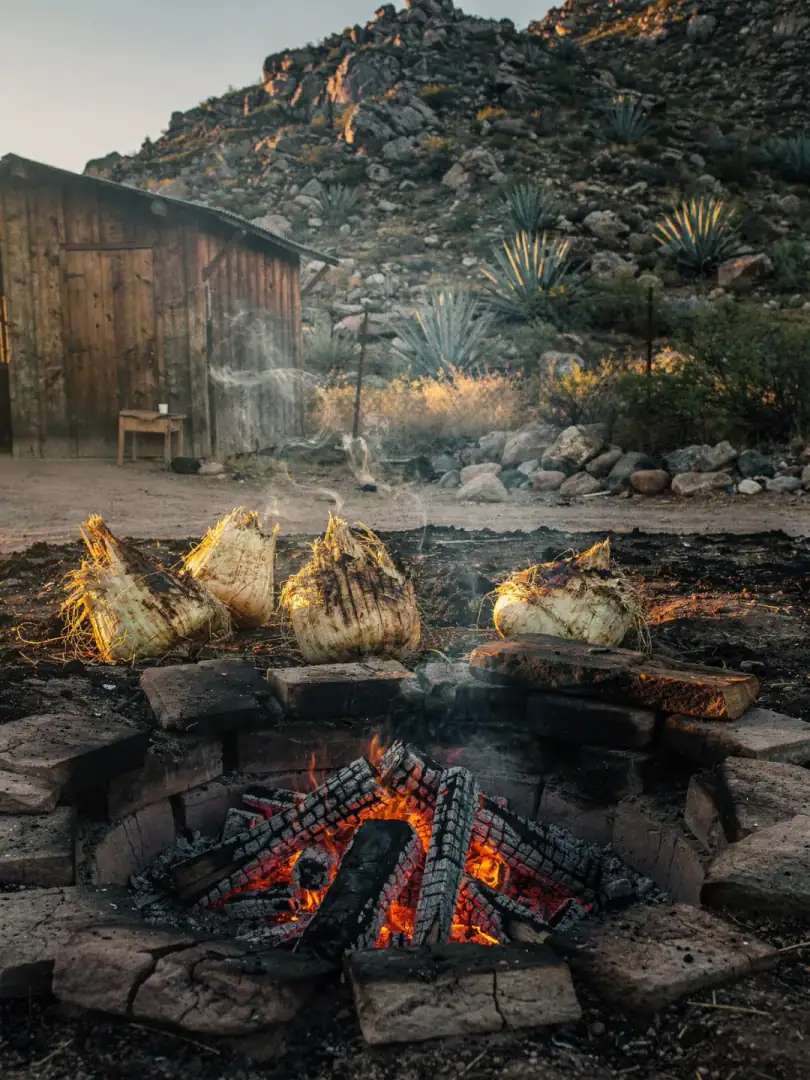
In the Vinata, as the small distilleries of Sonora are called, everything begins in the earthen pit. There, the peeled piñas cook for two days under a layer of earth and glowing mesquite charcoal. Afterward they smell soft and lightly sweet-smoky.
Exactly how a Vinata cooks and mills its agave depends heavily on the operation. Some of the nearly 38 registered distilleries in the Sierra hold firmly to pure handwork. Others have mechanized parts of the process, without giving up the earthen pit entirely.
Mesquite wood is no side detail. It shapes the flavor decisively, because it burns hot and evenly. In doing so, it passes an earthy, smoky note on to the agave, one that many Bacanoras still carry through to the glass.
After cooking, the piñas are chopped into pieces and fed into a mill, which presses the juice from the fibers. In Oaxaca, a horse often still pulls the stone tahona for Mezcal Artesanal. Many Sonora Vinatas, by contrast, now work with mechanical mills, without the spirit losing its name as a result.
Some large Tequila operations in Jalisco instead steam their agave in an autoclave or dissolve it in a diffuser with hot water. None of that has anything to do with Bacanora. Those methods belong to a different category, in a different state, with a different agave.
At the end of the cooking, what remains is a pile of soft, dark fibers and juice that smells of burnt wood and roasted sweetness. From this raw material, fermentation begins in the next stage.