Young & Pechuga
Aging
Hardly any Mezcal from the Valles Centrales spends years in a barrel. Most is drunk young, as Joven or Blanco, straight after distillation. For many palenqueros in Santiago Matatlán, this isn't a compromise but a conviction. Only unaged, they believe, does Mezcal still show the full character of the agave and the oven, without a barrel masking anything.
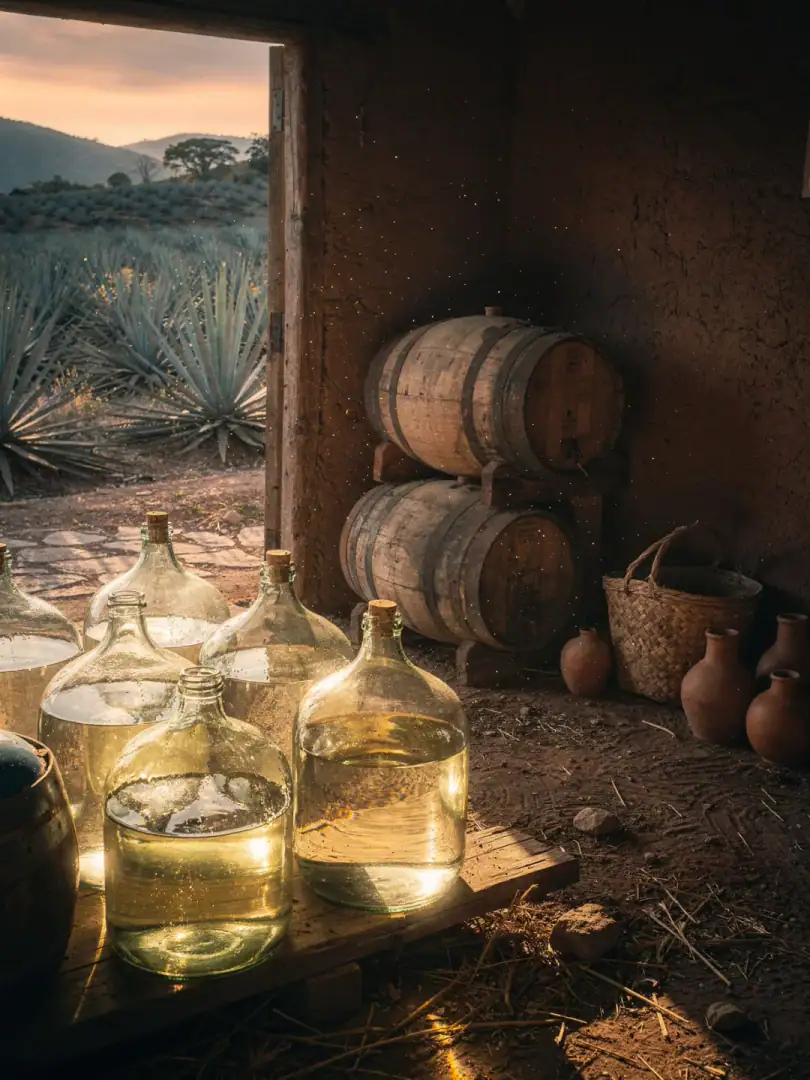
Those who do want to age it often skip wood entirely and use large glass demijohns instead, known as "Madurado en Vidrio." These sit for months in sunlight or darkness, and the Mezcal changes slowly through light, temperature, and time itself, not through contact with wood.
Reposado and Añejo, familiar from Tequila, also exist for Mezcal, though they're rarer in the Valles Centrales than in, say, Jalisco. Reposado requires at least two months in an oak barrel, Añejo at least a year, in barrels up to 600 liters.
One specialty of this region is Pechuga. For celebrations like Day of the Dead or a wedding, the Mezcal is distilled a third time, this time with fruit, spices, and a raw chicken or turkey breast suspended in the vapor above the still. The label must then read "Destilado con," followed by whatever was distilled alongside it.
Every bottle from the region must also state which of the three categories, Mezcal, Artesanal, or Ancestral, it belongs to, and how many agave species it contains, such as Espadín. Only these mandatory declarations make the name on the label true.