Cork and Screw Cap
Opening
Opening a bottle sounds simple, until the cork crumbles or the sparkling wine sprays across the table. Cork, screw cap, and sparkling wine each call for their own calm, deliberate hand movement.
The Corkscrew and Its History
English inventor Samuel Henshall patented the first standalone corkscrew design in 1795. A small disc above the spiral compresses the cork further as it turns. Almost a century later, in 1882, Karl Wienke of Rostock patented the so-called waiter's friend. This foldable tool with a lever is still carried by waiters today.
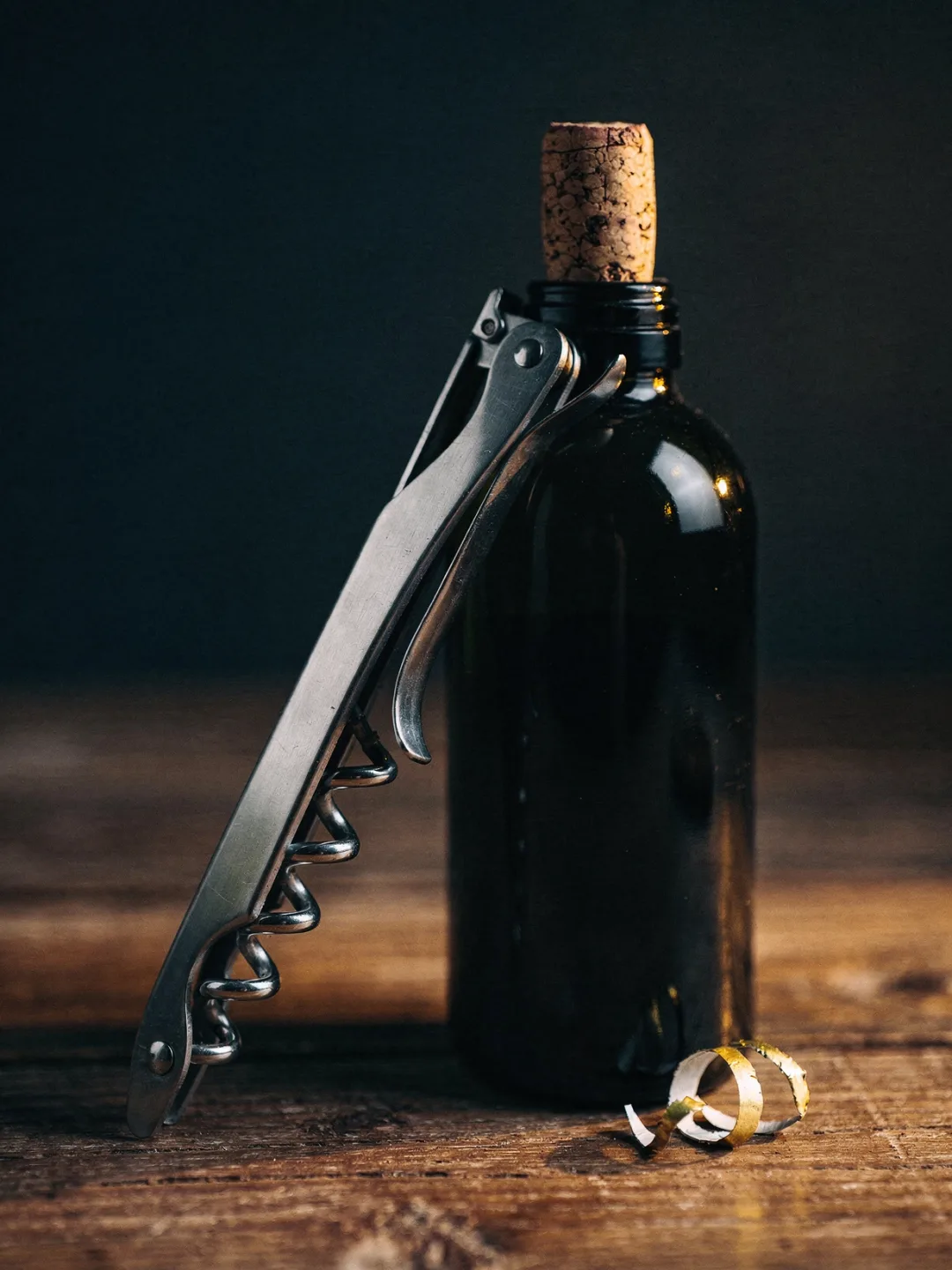
The principle of the waiter's friend remains unchanged to this day. A small blade cuts the capsule, the spiral screws into the cork, and a lever braces against the bottle's rim. This means the cork doesn't have to be pulled with pure arm strength. This leverage makes the tool easier to master than a plain pull-style opener without a lever.
Pulling a Cork Correctly
First, the capsule is cut cleanly below the bottle's lip, not at the very top of the neck, so no metallic taste transfers to the rim of the glass you'll later pour into. The spiral is centered on the cork and screwed straight down until only one coil remains visible. If it goes in at an angle, the cork tends to tear through the middle when pulled.
When pulling, draw slowly and straight, never yanking to the side, and press gently against the cork just before the final release to avoid a loud pop. A soft, almost inaudible sigh as the cork releases is considered by connoisseurs a sign of a bottle that's rested calmly. A loud pop, on the other hand, reveals too much movement or warmth before opening.
Screw Caps Without Guilt
In 2000, thirteen winemakers in Australia's Clare Valley, led by Jeffrey Grosset, switched their entire Riesling vintage to imported screw caps. Many merchants advised against it, fearing damage to the wine's image. The opposite happened: by 2016, ninety-eight percent of all white wines in Australia and New Zealand were sealed with screw caps.
The reason was quality, not cost-cutting. Screw caps allow no cork taint whatsoever and protect delicate, aromatic white wines from oxygen more reliably than many natural corks. Opening takes just a single twist, no tool required, and the quiet crack of the capsule breaking for the first time has by now become perfectly normal, even on better bottles.
Opening Sparkling Wine Safely
Inside a Champagne bottle, the second fermentation builds up an internal pressure of around six bar, comparable to the tire pressure of a truck, and considerably more if the bottle has been stored warm. This pressure turns the cork into a small projectile if it's allowed to pop out uncontrolled, which is why a loud bang isn't a sign of celebration but of poor technique.
The correct method is to hold the bottle at roughly a forty-five-degree angle, grip the cork with a cloth, and turn the bottle, not the cork. Keep your thumb firmly on the cork until a quiet hiss, rather than a bang, slowly releases. The bottle's opening should never point toward people or glasses.
When the Cork Breaks
Sometimes an old, brittle cork breaks the moment the spiral is inserted, especially with bottles that have rested for many years. In that case, insert the spiral again slightly off to the side, roughly at a forty-five-degree angle from the first attempt. This way it bites into intact cork material instead of the same weakened spot.
If the cork still slips into the bottle, there's no need to panic. The wine remains perfectly drinkable, only a few cork crumbs may float on top. A clean cloth or a fine sieve while pouring catches most of the crumbs before they land in the glass and disrupt that first sip.
Old Bottles with a Wax Seal
Some aged bottles, particularly from warmer regions, are sealed with a wax capsule instead of a simple foil, to better protect the cork from drying out. This capsule is best carefully chipped away with the blunt side of a knife rather than cut smoothly like foil, since hard wax otherwise breaks unpredictably. For very old collector's bottles, a special wax knife, available from specialty shops, is also worth having.
Small wax splinters that fall into the neck are most easily fished out with a clean, dampened cloth before pulling the cork. Anyone who pours immediately instead risks a few wax crumbs ending up in the glass—harmless, but unappealing.