Grapes of a Homeland
Native Grape Varieties
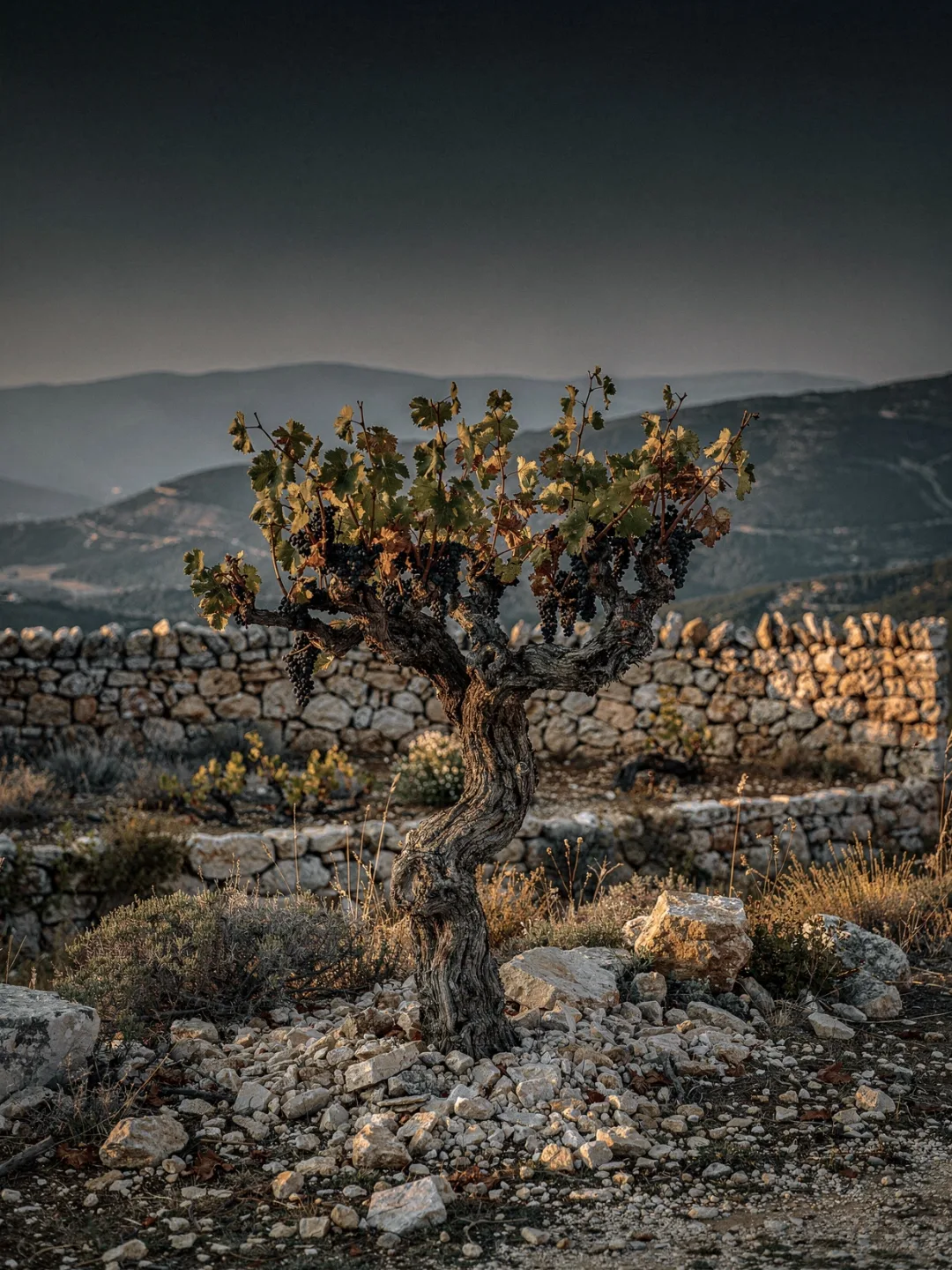
Not every grape variety wants to travel the world. Native grape varieties grow where they've been at home for generations, and often nowhere else in any meaningful quantity. This stop explains why such varieties remain so closely tied to a single place and why they're once again in demand today.
What "Native" Actually Means
The word autochthonous literally means "arisen from the earth itself." In wine terminology, it refers to a variety that has been native to a specific region for a very long time. There, it delivers its best, and often its only good, results. Unlike Cabernet Sauvignon or Chardonnay, such varieties can hardly be transplanted elsewhere without losing much of their character. Some winemakers even speak of a variety's "terroir memory" in describing this close bond, since over generations it essentially learns to work with the particularities of a specific place.
The reason lies in a fit between vine, climate, and soil that has developed over centuries. This fit can't simply be copied elsewhere. A Silvaner grown on Franconian shell limestone therefore tastes noticeably different from the same Silvaner grown on sandy soil elsewhere. Internationally planted varieties tend to smooth over such differences more easily. Conversely, trials with internationally planted varieties often show just how quickly their character adapts to a wide range of soils and climates, without losing its recognizable identity.
Examples from German Wine Regions
Silvaner has been considered a hallmark of Franconia since the 17th century. There, it produces earthy, hearty white wines that rarely convince as much elsewhere. Gutedel, known as Chasselas in Switzerland and France, has been grown for centuries mainly in Baden around Lake Constance. There, it yields light, uncomplicated white wines with delicate fruit. Old Silvaner vines in Franconia sometimes reach well over fifty years of age, lending their wines extra depth and concentration.
Lemberger, known as Blaufränkisch in Austria, in turn defines Württemberg. There, it produces spicy, tannin-driven red wines. Schwarzriesling, botanically known as Pinot Meunier, quietly leads a second life there, far removed from its main role as a blending partner in Champagne. For connoisseurs, this very combination of spice and tannic power is the hallmark of a true Württemberg Lemberger, regardless of vintage.
Examples from the Rest of the Wine World
On the Greek island of Santorini, Assyrtiko defies scorching heat and wind. Its acidity remains remarkably lively throughout. It grows in volcanic ash rather than ordinary soil. In Piedmont, Nebbiolo produces truly great wines only on a few hills around Barolo and Barbaresco. Planted elsewhere, it usually remains disappointingly unremarkable. In Sicily and Croatia, meanwhile, nearly forgotten native varieties keep resurfacing whenever individual winemakers rediscover and replant old vineyards, some of them centuries old.
Such examples reveal a clear pattern. Native varieties are rarely the easiest choice for a winemaker. But they're often the only ones that truly capture the character of a specific place. That's exactly what makes them so fascinating for curious wine drinkers. This close tie to a single, unmistakable place is precisely what turns such wines into a kind of liquid map for the curious drinker.
Why These Varieties Are Back in Demand Today
For decades, internationally known varieties like Cabernet Sauvignon or Chardonnay pushed aside many local vines. They were simply easier to sell. In recent years, the trend has reversed. Wine drinkers are increasingly seeking out varieties they don't yet know. Winemakers are pulling up old vines less often than before. Wine bars and sommeliers also contribute to this shift in thinking, by deliberately featuring small, unknown producers on their wine lists rather than relying solely on well-known international varieties.
Support is also coming from EU law. Since Regulation (EU) 2024/1143, protected designations of origin and geographical indications have been newly regulated. This system indirectly protects and honors native varieties tied to a particular region. Anyone who today spots an old, little-known name on a label is often holding a piece of lived local history in their hands. In the long run, this renewed appreciation for old varieties even helps safeguard genetic diversity, which could prove valuable as a reserve for future breeding in the face of climate change.