Tank or Barrel
White Wine Styles
Two bottles of Chardonnay from the same region can taste completely different—not because of the grape, but because of the choices made in the cellar. This stop explains which techniques turn the same white variety into either a crisp or a creamy wine.
Steel Tank versus Barrique
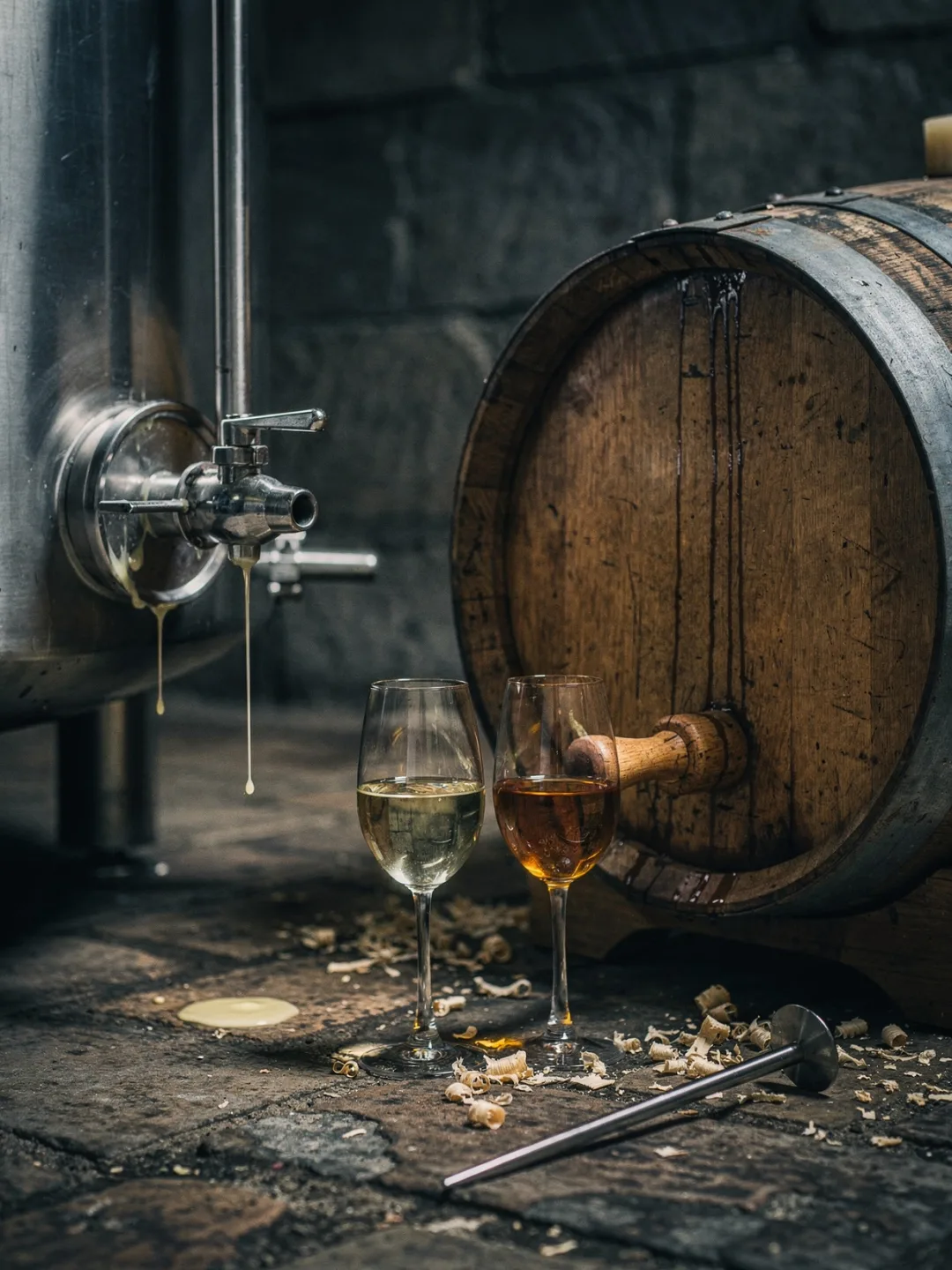
If a winemaker ferments and ages white wine in a neutral steel tank, the fruit of the grape stays front and center. The wine comes across as crisp, clear, and usually rather lean. This is typical of many Sauvignon Blancs or straightforward Rieslings. If the same wine instead ages in a barrique—a small oak barrel, usually made of French or American oak—the character changes noticeably. It picks up toasty notes like vanilla, toast, or coconut. Some winemakers deliberately combine both approaches, aging part of the harvest in steel tank and another part in barrique, then blending the two back together later.
New oak also releases tiny amounts of oxygen through its pores. This makes the wine rounder and softer, but it also costs the wine some of its original fruit character. The more often a barrel has already been used, the less flavor it still imparts to the wine. A barrel used for a third or fourth time behaves almost like a neutral vessel. A skilled cooper can predict fairly accurately, based on a barrel's origin and toasting level, what flavors it will later give to the wine, even before it's filled.
Malolactic Fermentation: From Sharp to Soft
During malolactic fermentation, lactic acid bacteria convert the sharp malic acid of the young wine into milder lactic acid. The very same process is familiar from yogurt or sauerkraut. The wine loses some of its sharpness as a result, and often gains a creamy, sometimes buttery note. This note is caused by a compound called diacetyl. Outside the wine cellar, too, this bacterial transformation shows up constantly, for instance when fresh milk slowly ripens into slightly tangy yogurt.
For robust, often oak-aged Chardonnays, this step is standard practice. With Riesling, however, most winemakers deliberately skip it. The sharp malic acid is precisely part of this variety's character; it defines its signature freshness. Some winemakers therefore deliberately let only part of their Chardonnay undergo this conversion, in order to balance freshness and creaminess in the finished blend.
Lees Aging: Texture Without Extra Aroma
After fermentation, dead yeast cells settle as a fine sediment known as lees. If a winemaker leaves the wine on these lees for an extended period and occasionally stirs them up, the wine changes noticeably. The cells contribute structure and a slightly bready, nutty note, without making the wine heavier. The more finely the lees are stirred, the more evenly their effect spreads throughout the entire tank or barrel, rather than staying concentrated at the bottom.
This technique is known in French as sur lie. It shapes French Muscadet, for example, and it shapes many modern Chardonnays just as much. Texture and aroma can be shaped deliberately this way, entirely without the use of an oak barrel. For many winemakers, this technique is a preferred tool for giving a wine that's not at all oak-driven some extra depth nonetheless.
Sweetness as Its Own Question of Style
Alongside aging and acidity, residual sweetness also determines a white wine's style. German wines broadly distinguish between dry, off-dry, and sweet. What matters is how much unfermented sugar remains in the finished wine. High acidity can offset a surprising amount of sweetness. The wine then still doesn't taste heavy or cloying. In top-tier noble sweet wines, residual sugar can even sit well above a hundred grams per liter without the wine coming across as heavy or syrupy.
This very interplay of sweetness and acidity explains an apparent contradiction. A sweet Riesling with plenty of acidity often tastes fresher than a dry wine from a warm, low-acid region. How strongly this balance can even form its own category becomes clear later in the station on sweet wine. For exactly this reason, experienced tasters never judge a wine on sweetness alone, but always in direct relation to its acidity.