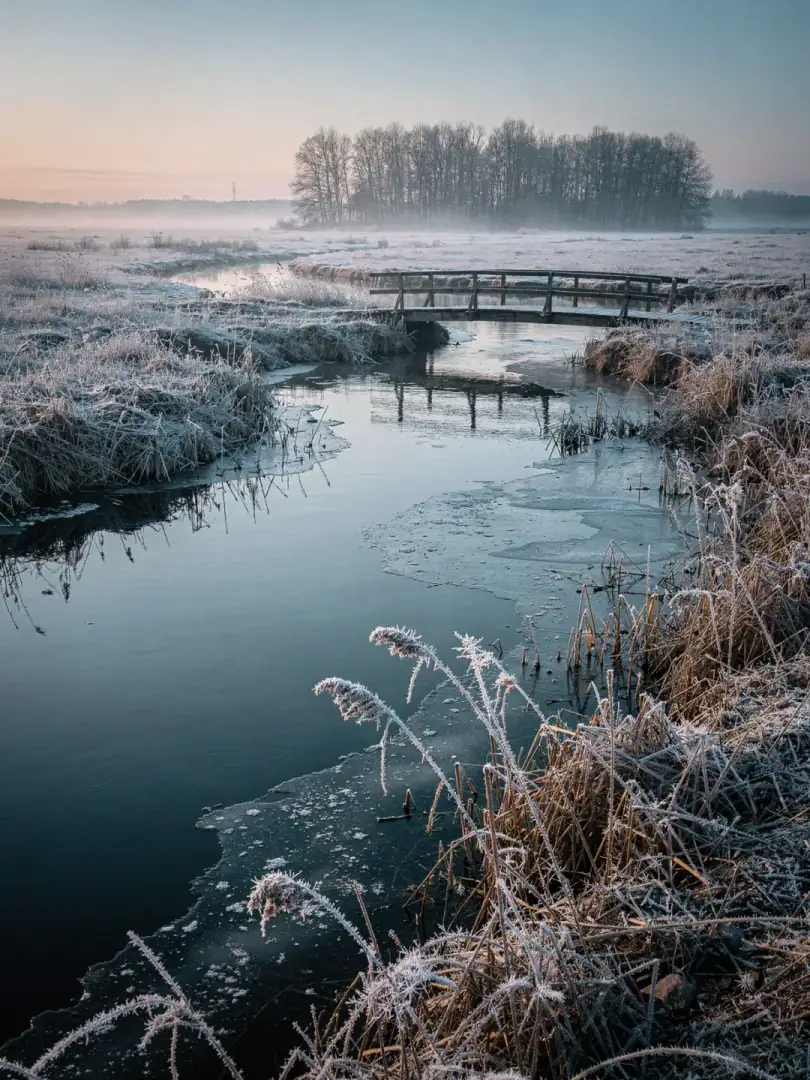
Marshes & Frost
Water & Climate
Two rivers give the landscape its rhythm. The Narew winds through the land in broad meanders. Its tributary, the Biebrza, carries one of Europe's largest lowland marshes along its banks. Here, water seeps through peat and sand. It arrives in the groundwater filtered and low in minerals, exactly what grain spirit rectification requires.
The climate sharpens these conditions even further. Podlachia is considered the coldest region in Poland, with long, harsh winters and short summers. Its typical continental transitional climate sits between the Baltic Sea and the continental interior. Between 550 and 700 millimeters of annual rainfall is enough for the rye fields. But it's the frosts that determine when to sow and when to distill.
Cold winters mean fermentation starts late. They also bring water that's naturally low in microbial contamination, an advantage for the distillation that follows. The Biebrza marshes themselves have been a national park since 1993. They act as a natural filter for the groundwater across the whole region before it reaches the surrounding distilleries.
The distilleries in the region make direct use of this cool, mineral-poor water. They use it to dilute the high-proof raw alcohol down to drinking strength after rectification. Softer water means less limescale haze in the bottle and a cleaner first sip. The landscape hands this advantage to the distillery essentially for free.
The forest streams around Białowieża feed the same system. Rain and meltwater seep through moss and deadwood before continuing underground. This keeps the groundwater cool and consistent over long stretches. That holds true even when summers are short and winters long.