Bought In, Lightly Hopped
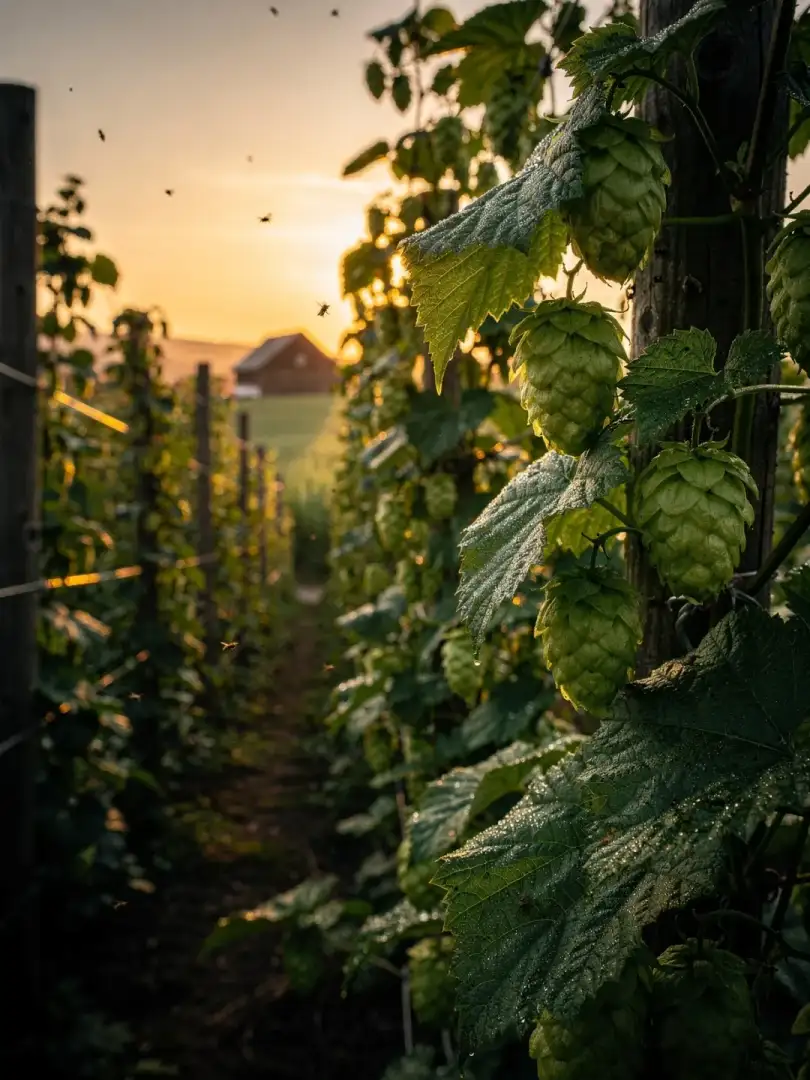
Hops
Does hops grow in the Münsterland? No, the region has no significant hop-growing areas. In 2025, German hops grow on roughly 18,962 hectares, about 83 percent of it in the Hallertau in Bavaria, with further areas in Tettnang on Lake Constance, Spalt in Franconia, and the Elbe-Saale region. Westphalia and Ostwestfalen buy their hops in.
Hops contribute two things to beer. Alpha acids provide bitterness, while essential oils bring aromas of herbs, grass, or blossom. Both can be measured and controlled: the IBU bitterness unit indicates how bitter a beer actually is, with a German Pils typically falling between 22 and 40 by style standard.
Each brewery has its own signature. A Pils like Herforder or Paderborner Pilsener pushes the hops to the forefront, with a dry, assertive bitterness in the finish. Münstersch Alt, by contrast, is hopped more restrained, so the malt and the light fruitiness of the top-fermenting yeast aren't masked.
At Pinkus, the same principle applies to hops as to malt: they come from organic farming, and brewer and farmer typically know each other personally. Which varieties the brewery uses depends on the vintage, and cultivation varies from harvest to harvest, so there's no fixed variety list.
Anyone wanting to connect the landscape to hops should look to the Hallertau, not Westphalia. Here, the region's role lies in the recipe and the sourcing: from bought-in hops comes a beer that tastes different from one brewed in Bavaria or the Rhineland, because yeast, water, and malt all have their say.