From the Bottle
Pouring Beer the Right Way: How to Get It Right from the Bottle
Start at an angle, finish upright: beer from a bottle first runs down the wall of a tilted, clean glass, then you straighten the glass, and the head builds up in the center. Wheat beer and bottle-conditioned Belgian beers call for their own techniques.
Why Does the Glass Need to Be Beer-Clean?
Before the first beer flows, the glass already decides the outcome. Foam consists of bubbles whose shell is formed mainly by protein from the malt and bitter compounds from the hops. Even tiny traces of grease, lip balm or dish soap destroy these shells. Then the head collapses, and large, individual bubbles cling to the glass wall, a sure sign of a dirty glass.
Beer glasses should therefore be washed without grease residue and without rinse aid, which leaves a wafer-thin film, and left to air-dry rather than wiped with a lint-leaving cloth. Just before pouring, a splash of cold, clear water helps: it cools the glass slightly and forms an even film on which the beer settles calmly. If the glass is clean, a ring of foam remains on the wall after every sip, something experts call lacing.
How Do You Pour Pils or Helles Correctly?
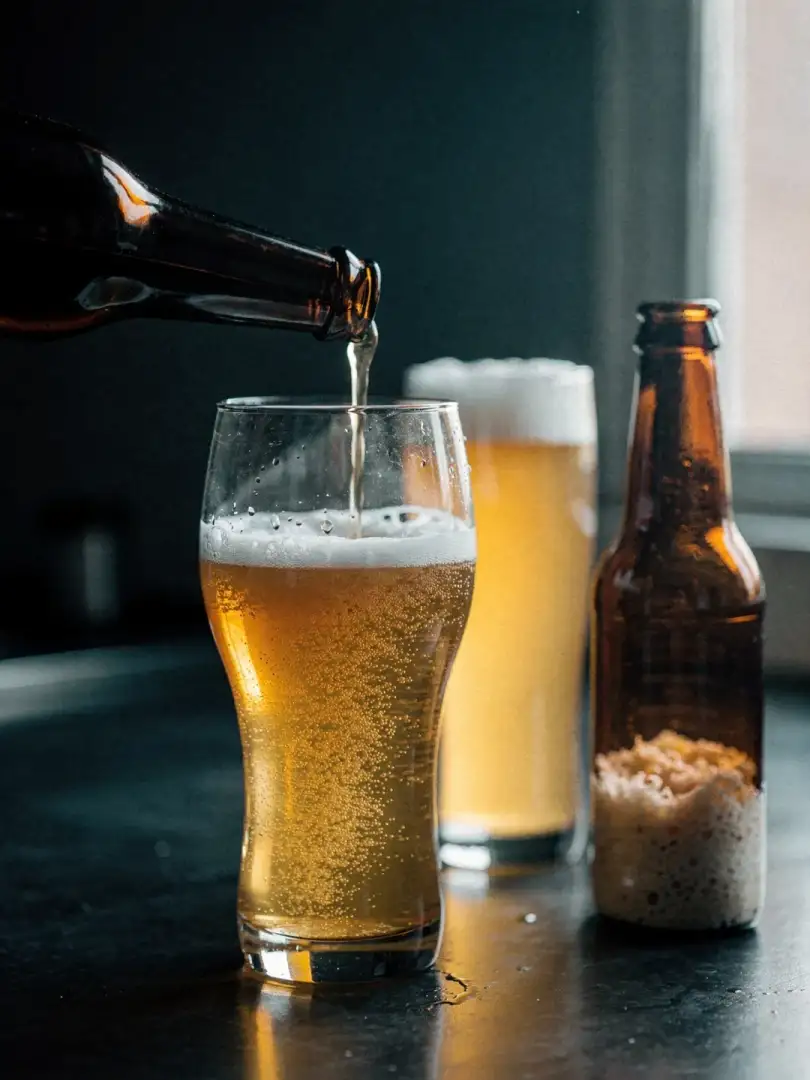
Hold the glass at a slight tilt, roughly a 45-degree angle, and let the beer run down the inner wall close to the rim. This way little carbonation escapes, and barely any foam forms. Once the glass is about half full, slowly straighten it and pour the rest down the center, with a bit of drop height. Now carbonation is released and the head builds. If the foam rises too quickly, pause briefly, then continue pouring until it domes over the rim.
How much foam is correct depends on the style and on habit. For Pils, a firm head roughly two to three fingers tall is considered ideal in Germany. Foam isn't a waste: it holds the aromas in the glass and gives the beer a little protection from air. Pouring with no head at all keeps more carbonation in the beer, which then comes across as fizzier and often a bit sharp.
Pouring Wheat Beer: What Happens to the Yeast?
Hefeweizen contains yeast that settles at the bottom of the bottle. Rinse the wheat beer glass with cold water, tilt it steeply, and let the beer run down the wall very gently, since hardly any beer foams as vigorously. Some people place the glass over the bottle and flip both together. It looks elegant but isn't required. Just before the end, a small amount remains in the bottle.
Swirl this remainder to loosen the yeast from the bottom, then pour it on top. This makes the beer evenly cloudy and a bit fuller in the mouth. With Kristallweizen, a filtered, clear wheat beer, this step is skipped because there's no yeast in the bottle. Whether you like the yeast sediment is a matter of taste. Anyone who wants a fresher, paler glass can leave the sediment in the bottle even with Hefeweizen.
Belgian Bottle Conditioning: Better to Leave the Sediment in the Bottle
The situation differs for many Belgian beers. Tripel, Dubbel or Saison are often bottle-conditioned: a bit of sugar and fresh yeast are added at bottling, and the secondary fermentation in the bottle produces the carbonation. This yeast forms a firm sediment that tastes yeasty and slightly tart. The usual approach is to pour calmly, ideally in one go, and leave the last centimeter along with the sediment in the bottle.
Such bottles are best stored upright for a few days so the yeast settles at the bottom. Taking one straight from the shelf and opening it immediately clouds the beer unnecessarily. With bottled lagers this question rarely arises, since they're usually filtered. An exception is naturally hazy Kellerbier: here the fine haze is part of the style, and gently swirling the bottle before opening distributes it evenly.