Classic Aroma Varieties
Noble Hops: Hallertau, Saaz, Tettnang, Spalt
Noble hops isn't a legal term but a trade name for four old Central European aroma varieties: Hallertauer Mittelfrüh, Saaz, Tettnanger, and Spalter. They're low in alpha acid, rich in humulene, and have a delicate, herbal-floral aroma that defines Pilsner and Helles.
What Are Noble Hops? A Term from the Trade
No law or authority defines which hops count as noble. The English term noble hops spread through the hop trade in the 20th century; in German, they're also called fine aroma hops. The term generally refers to four landrace varieties, selectively bred over centuries in their home regions. They're closely related and each carries the name of its homeland.
What they share is a low alpha acid content, often three to five percent, a high proportion of humulene in the oil, and little cohumulone. The result is a delicate, barely harsh bitterness and an aroma of hay, herbs, florals, and mild pepper. Achieving a solid base bitterness requires large amounts of these varieties, which is why many breweries today combine them with higher-yielding bittering varieties.
Hallertau Hops: The World's Largest Growing Region
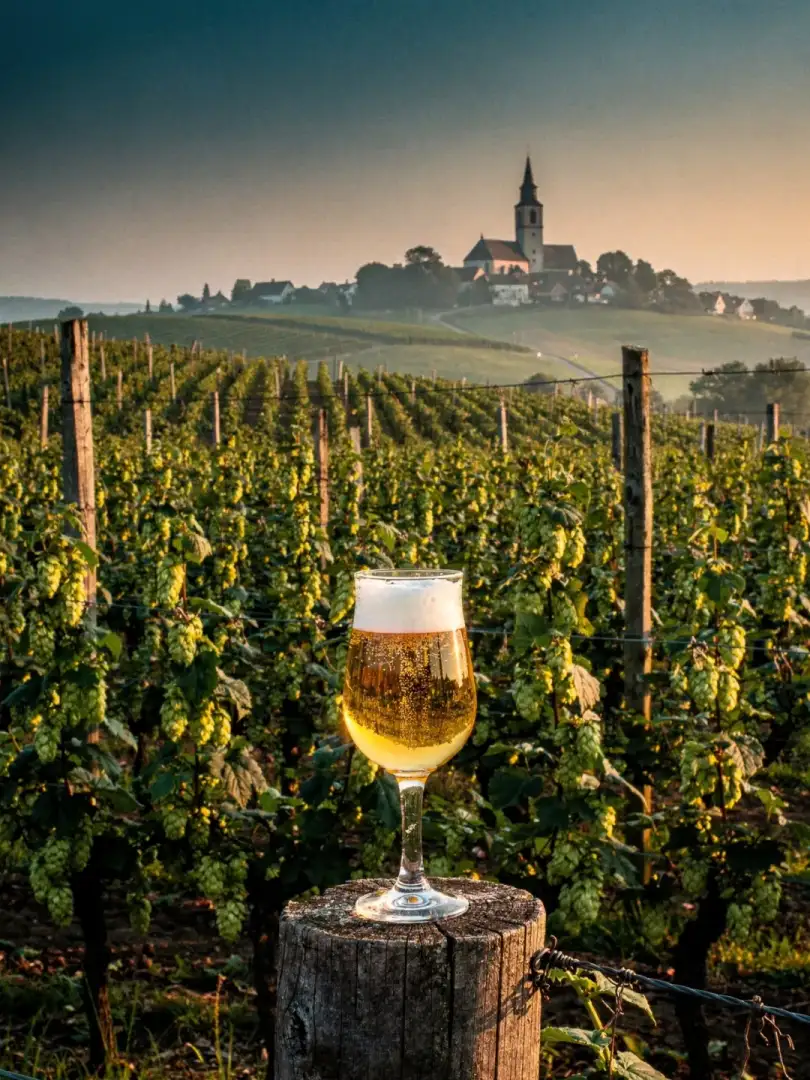
The Hallertau lies in Bavaria between Ingolstadt, Landshut, and Freising. In 2025 Germany cultivated just under 19,000 hectares of hops, with by far the largest share grown here; the Hallertau is considered the largest contiguous hop-growing region in the world. A document from 736 mentioning hop gardens near Geisenfeld is often cited. Its authenticity is disputed, however; hop gardens in the Diocese of Freising are only reliably documented from the 9th century onward.
Hallertauer Mittelfrüh is the old landrace of the region. It's susceptible to verticillium wilt, a fungal disease, and is therefore grown on only a small acreage today. Successors like Hallertauer Tradition or Perle come from breeding work at the Hüll hop research center. In a Munich Helles or a Festbier, such varieties deliver a quiet, round bitterness and a touch of florals.
Saaz Hops and Bohemian Pilsner
Saaz is called Žatec in Czech and lies in northwestern Bohemia. Hops from this region are registered in the EU as a protected designation of origin, "Žatecký chmel." The best-known variety is Saazer Halbfrüher Rotreber, known in Czech as Žatecký poloraný červeňák, named for the reddish coloring of its bines.
Saazer brings spicy, hay-like notes and a delicate citrus freshness to the nose, with a soft bitterness on the palate. Josef Groll, a Bavarian brewer, brewed the first batch of pale bottom-fermented beer in Pilsen on October 5, 1842, from which Pils emerged. Saazer hops, very soft water and pale malt have defined Bohemian Pils to this day. It comes across as fuller and rounder than many German Pils beers, even though the bitterness can be high.
Tettnang and Spalt hops: small regions, distinct character
Tettnang lies near Lake Constance in Baden-Württemberg. Around 1,500 hectares are planted with hops there, with commercial cultivation dating back to 1844. Tettnanger is closely related to Saazer and has a floral aroma, with herbs and a hint of lemon. Spalt in Middle Franconia, south of Nuremberg, is even smaller. Spalter hops are considered spicy and fine, with a long brewing tradition in Franconia.
Both names appear as origin designations on hop sacks and sometimes on beer labels. As with wine, the same variety tastes different in a different place, because soil, rainfall and hours of sunshine change oils and acids. A Tettnanger grown in America is therefore not the same as one from Lake Constance. The origin name thus reveals more than the variety alone.
Noble hops in the glass: German Pils, Bohemian Pils, Helles
German Pils is usually leaner, drier and more distinctly bitter than its Bohemian model. It often uses Hallertau or Tettnanger aroma varieties, frequently supplemented with a bittering variety for the base bitterness. Bohemian Pils carries more malt body and a gentler bitterness with Saazer spice.
Helles uses the same hops, but sparingly, so that the aroma lies only as a hint over the malt. Kölsch, too, traditionally relies on German aroma varieties. Here, however, the top-fermenting yeast takes over part of the aroma with a light fruitiness, and cold storage smooths everything out. You can't identify these styles from the hops alone; only the amount, malt and yeast together create their profile.