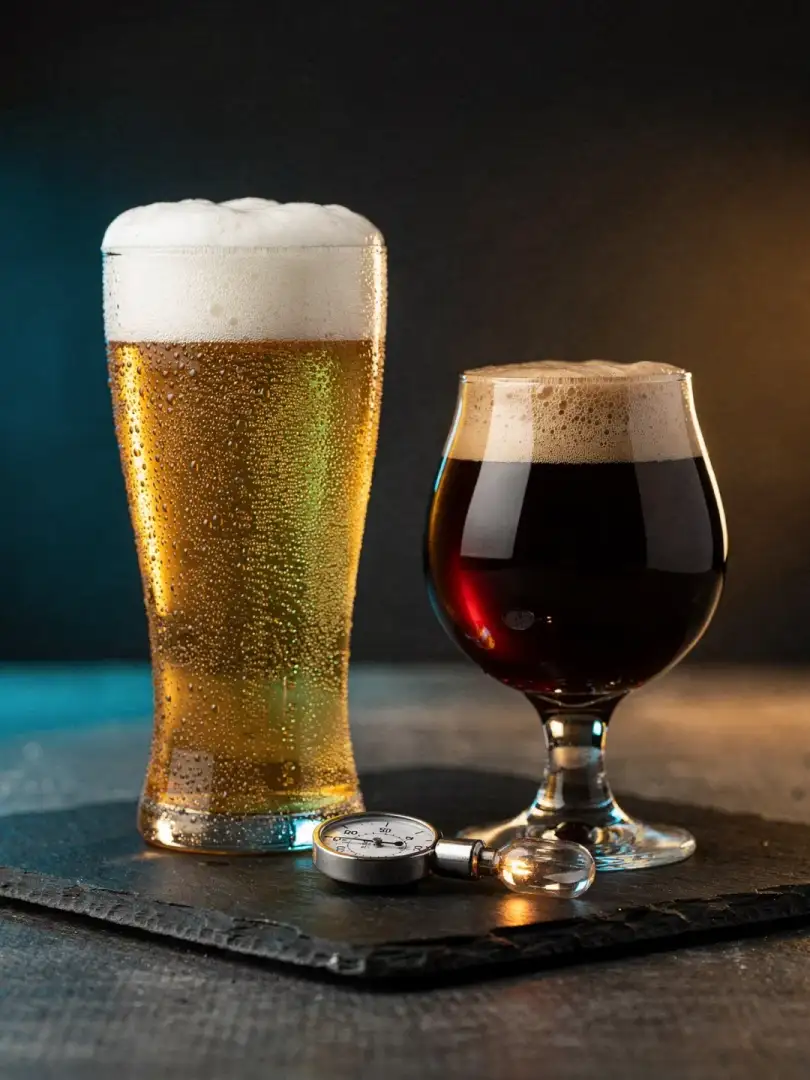
Temperature and flavor
Drink beer ice cold? Finding the right serving temperature
Ice cold isn't automatically better. Cold dulls sweetness and aroma—great for refreshing light lagers, but it strips bolder beers of their character. Pale lagers taste best around 6 to 8°C (43 to 46°F), while dark and strong beers do better around 10 to 14°C (50 to 57°F).
Why does cold beer taste less flavorful?
Our tongue and nose simply work less effectively in the cold. Aroma compounds evaporate more slowly at low temperatures, so less of them reach the nose—and most of what we perceive as flavor actually comes through smell. Our perception of sweetness is also temperature-dependent. A research team from Leuven showed in 2005 that a sweet-taste receptor responds far more strongly in warmth than in cold.
Cold, by contrast, emphasizes carbonation and bitterness. An ice-cold beer therefore feels fizzier, leaner, and harsher. That's desirable in a simple, light lager meant to refresh. But in a beer rich with malt and yeast character, the cold strips away exactly what the beer was brewed to deliver.
What temperature suits which beer?
There are no fixed standards for serving temperature. But beer sommeliers and breweries tend to recommend similar ranges that have proven reliable as rules of thumb. Light, pale lagers like Pils or Helles taste best around 6 to 8°C (43 to 46°F). Weissbier sits in a similar range, though some prefer it slightly warmer to bring out the banana and clove notes more clearly.
Bolder beers need more warmth. Märzen, Dunkel, and Altbier open up around 8 to 10°C (46 to 50°F). Bock, Doppelbock, strong Belgian beers, stout, and barley wine only reveal their caramel, dried fruit, and roasted malt character around 10 to 14°C (50 to 57°F). A British cask ale—a beer conditioned in the cask with low carbonation—is traditionally served cellar-cool, around 11 to 13°C (52 to 55°F).
Warm English beer: just a myth?
Anyone trying a bitter for the first time in an English pub sometimes finds it lukewarm. That's where the stereotype of the British drinking warm beer comes from. In reality, cask ale comes straight from the cellar, making it cooler than room temperature but noticeably warmer than a pils straight from the fridge. The difference is deliberate: this beer has low carbonation and relies on soft malt character and earthy hops to shine.
Conversely, some lagers are deliberately served very cold, sometimes just above freezing. These beers are light, low in bitterness, and built purely for refreshment. Intense cold barely hides anything in them. But in a flawed beer—one with a slightly oxidized, cardboard-like taste, say—cold can mask such weaknesses. That's one reason tasters prefer to sample beer a bit warmer.
Why does warm beer taste flat?
Carbon dioxide dissolves better in cold liquid than in warm. A beer left sitting in the sun therefore loses its carbonation faster, the bubbles grow larger and sparser, and the beer starts to feel flat. That's exactly the sensation people mean by "flat." For a light lager that depends on freshness and fizz, that's a real loss.
That doesn't mean colder is always better, though. A beer left in the freezer can get too cold, ice crystals can form, and in the worst case the bottle can burst, since water expands as it freezes. Even just above freezing, a beer barely tastes like anything beyond cold and carbonation. So the goal isn't maximum cold—it's matching the temperature to the style. Rinsing the glass with cold water beforehand helps keep the beer at the right temperature once poured.
What remains an open question
How strongly temperature affects flavor is something everyone experiences differently. The ranges given here are practical guidelines based on experience, not precise figures backed by studies for every single style. What tastes too flat to one person at 8°C (46°F) might taste exactly right to someone else.
A simple test helps: try a glass of Bockbier straight from the fridge, then let it sit for ten minutes. With every degree of warming, the malt and fruit notes come through more clearly. For more on mindful tasting, check out the relevant tips in the chapter on tasting.