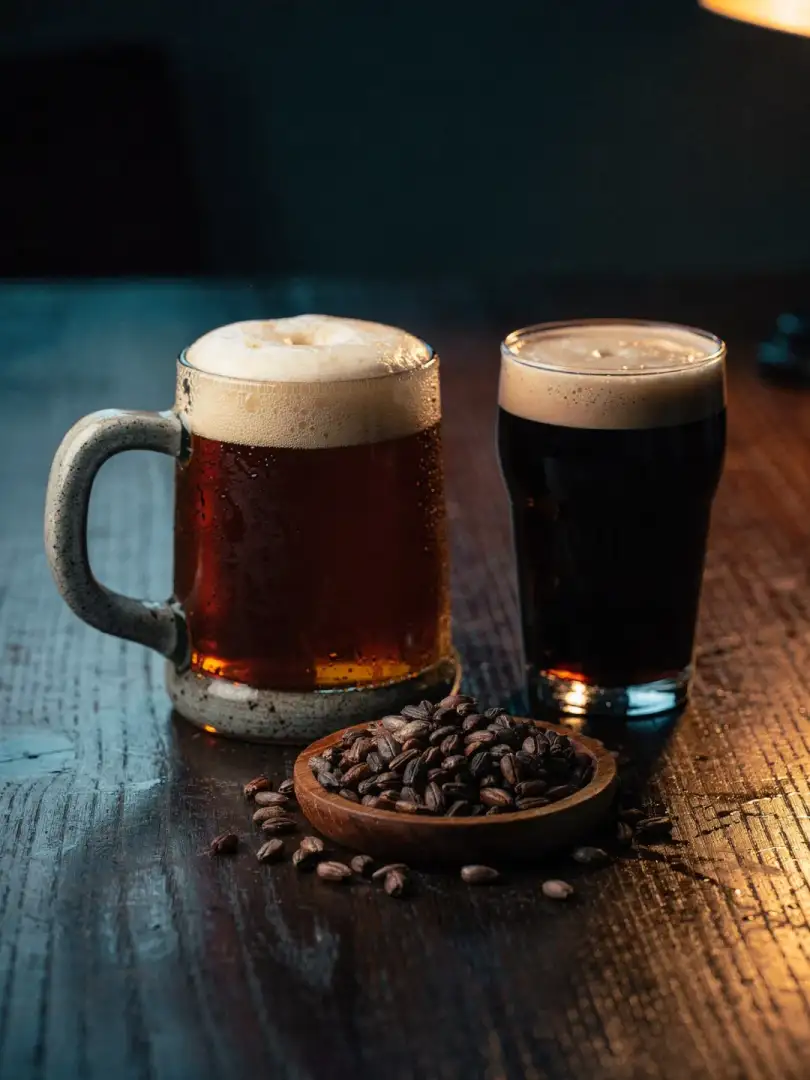
Carbonate and roasted malt
Munich and Dublin: dark beer from hard water
Carbonate-rich water is considered one reason why Munich was long known for dark beer, and why porter and stout became big in London and Dublin. Dark roasted malts bring acidity that balances out hard water. What's chemistry here, and what's legend.
Why does hard water suit dark beer?
Carbonate-rich water raises the pH of the mash, because bicarbonate buffers acidity. Pale malt doesn't bring enough acidity of its own to counteract this. Dark specialty malts, and especially roasted malts, are considerably more acidic. The more of these are in the grain bill—that is, the malt blend of a given brew—the better they balance out hard water, and the closer the mash gets to the range where enzymes work well.
For brewers in cities with such water, the conclusion was obvious even without any chemistry knowledge: dark beers turned out soft and round, pale ones tasted harsh. Conversely, strongly roasted malts in very soft water would make the mash too acidic. This explains part of the old beer map. But it isn't the whole truth, since taxes, malt prices and fashion also determined what a city drank.
Munich water and Munich Dunkel
Munich's groundwater comes from the gravel beds of the Alpine foothills and is considered carbonate-rich. For centuries, the typical Munich beer was therefore dark: a malty, bottom-fermented lager with notes of bread crust and caramel, known today as Münchner Dunkel. The BJCP guidelines give it a color of 33 to 55 EBC and a bitterness of 18 to 28 IBU—clearly more malt than hops.
Munich's pale beer, the Helles, only emerged toward the end of the 19th century, when the pilsner wave from Bohemia created pressure. To achieve this, brewers had to get their water under control, for instance through decarbonization, which removes the bicarbonate, or through biological acidification of the mash. Helles is thus itself a product of water treatment: without it, it would hardly have turned out so clean and mild in Munich.
London and Dublin: porter and stout
Porter emerged in 1720s London; its inventor is unknown. The oft-told story about the brewer Ralph Harwood comes from a book published in 1802 and has no earlier sources. London's water was considered carbonate-rich, and the dark, roasted malt of porter suited it well. From an especially strong porter came the "stout porter," later shortened to stout. The word originally just meant "strong."
Ireland, Guinness in Dublin above all, made stout world-famous, though it didn't invent the style there. Guinness itself states that its brewing water today comes from the Wicklow Mountains south of Dublin, never from the Liffey, even though that rumor persists stubbornly. The equation "hard Dublin water equals stout" should therefore be taken with a grain of salt. What's certain is that roasted malt tolerates hard water well.
Porter, stout, Dunkel: what sets them apart?
All three are dark, but for different reasons. Münchner Dunkel is bottom-fermented and relies on Munich malt, a strongly kilned but not roasted malt. It tastes of bread and nuts, with barely any coffee notes. Porter and stout are top-fermented and contain roasted malt or roasted barley, which brings notes of coffee, cocoa and bitter chocolate. An Irish stout, according to BJCP, is surprisingly light at 3.8 to 5% ABV.
Water links these beers, but doesn't separate them. Anyone brewing a stout today adjusts their water so the roast acidity doesn't become too sharp, and with very soft water often adds chalk or baking soda. A Dunkel can come from water that was partly softened beforehand. The historical pattern remains a good rule of thumb: the darker the malt, the more carbonate the water can tolerate.