Brandies from the winemakers themselves
Pomace brandy and lees brandy in Germany and Austria
In Germany and Austria, it's mainly wine estates that distill their own pomace and wine lees. Pomace brandy requires at least 37.5% ABV, lees brandy 38% ABV. Pomace and wine lees are among the raw materials a licensed small-scale distillery (Abfindungsbrennerei) is permitted to process. Neither may be called grappa.
Pomace brandy from Germany: winemakers distill their own pomace
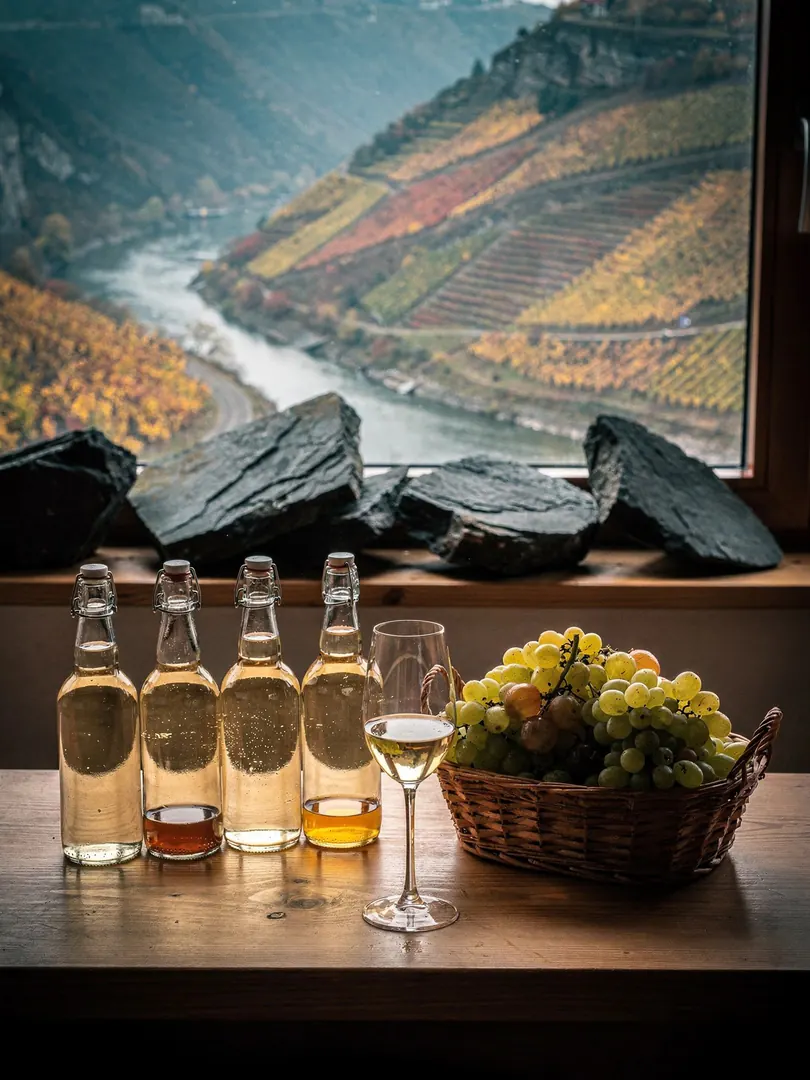
Visit a winery along the Mosel, in the Pfalz, or in Baden, and you'll often find a row of small bottles next to the wine in the tasting room. Among them there's almost always a pomace brandy, frequently named after the grape variety: Riesling pomace, Spätburgunder pomace, Gewürztraminer pomace. The winemaker distills whatever accumulates in their own cellar, carrying the signature of their wines into the brandy.
Legally, the product is called "pomace brandy" or simply "pomace," as permitted under EU Category 6. There's no registered designation of origin for German pomace brandy in the EU register. "Mosel pomace brandy" is therefore an indication of origin that must be accurate, but it isn't a protected geographical indication the way Grappa or Marc de Bourgogne are.
The grape variety strongly shapes the flavor of the brandy. Riesling pomace often comes across fresh, with notes of apple and citrus, while Spätburgunder pomace is darker, with cherry and bitter kernel notes; Muscat and Gewürztraminer bring their floral character along. Most German pomace brandies are bottled young and clear.
Licensed small-scale distilling: why winemakers can distill pomace
Distilling is illegal in Germany without a permit, even for personal use. Many wine estates therefore operate as a licensed small-scale distillery (Abfindungsbrennerei). There, distilling happens without customs seal, and the tax is calculated using a flat rate: based on the quantity of raw material and an official yield rate, the amount of alcohol produced is estimated. This flat-rate assessment is called the Abfindung.
The Alcohol Tax Act lists the permitted raw materials, including fruit, berries, roots, and explicitly wine along with its lees and pomace. A licensed small-scale distillery may produce no more than 300 liters of pure alcohol per year, and the permit requires an agricultural operation; in viticulture, 1.5 hectares is sufficient. Anyone without their own still can have their own pomace distilled at a licensed small-scale distillery as a material owner, up to 50 liters of pure alcohol per year. The finer details of distilling rights are a topic of their own; what matters here is that pomace and wine lees are recognized raw materials.
What is lees brandy? The brandy made from wine lees
After fermentation, a thick, creamy layer settles in the barrel: dead yeast cells and suspended particles, known as wine lees. Winemakers rack the young wine off this sediment. What remains still contains wine and plenty of flavor, and from this, lees brandy is made, often sold as wine lees brandy.
Under EU law it has its own category: lees brandy or brandy made from sediment (Category 12). Besides wine lees, beer or fruit sediment can also be used, and the brandy requires at least 38% ABV, higher than pomace brandy. In the glass, wine lees brandy tends to be softer and rounder, with notes of bread, yeast, nuts, and wine; pomace brandy is more robust and husk-like.
The line separating it from pomace brandy is drawn by the sediment rule: in a pomace brandy, only a small proportion of the alcohol may come from sediment. Anyone distilling predominantly lees must label their product as lees brandy.
Trebernbrand in Austria and Grappa in South Tyrol
In Austria, pomace is often called Treber or Trebern, and the brandy made from it is accordingly called Trebernbrand. There too, it's mainly winemakers and farmers who distill, many of them as licensed small-scale distillers registered with the customs office. Wine lees are also called Geläger in Austria; the lees brandy made from it follows the same EU rules as in Germany.
A special case lies just south of the Brenner Pass. South Tyrol is German-speaking but belongs to Italy, and this allows South Tyrolean distilleries to call their pomace brandy Grappa. The EU register even lists its own designation: Südtiroler Grappa or Grappa dell'Alto Adige. So a Gewürztraminer pomace brandy from Tramin is called Grappa, while one from the Pfalz is simply called pomace brandy, even though both may be distilled from the very same grape variety.