Origins of Rum
Where Does Rum Come From? From Asia via Madeira to Barbados
Rum takes its name and its identity as a trade good from Barbados, where sugarcane spirit became known around 1650. Sugarcane had been distilled earlier, in South and Southeast Asia, on Madeira, and in Brazil. No one invented it in any single place.
Where Does the Sugarcane Used for Rum Come From?
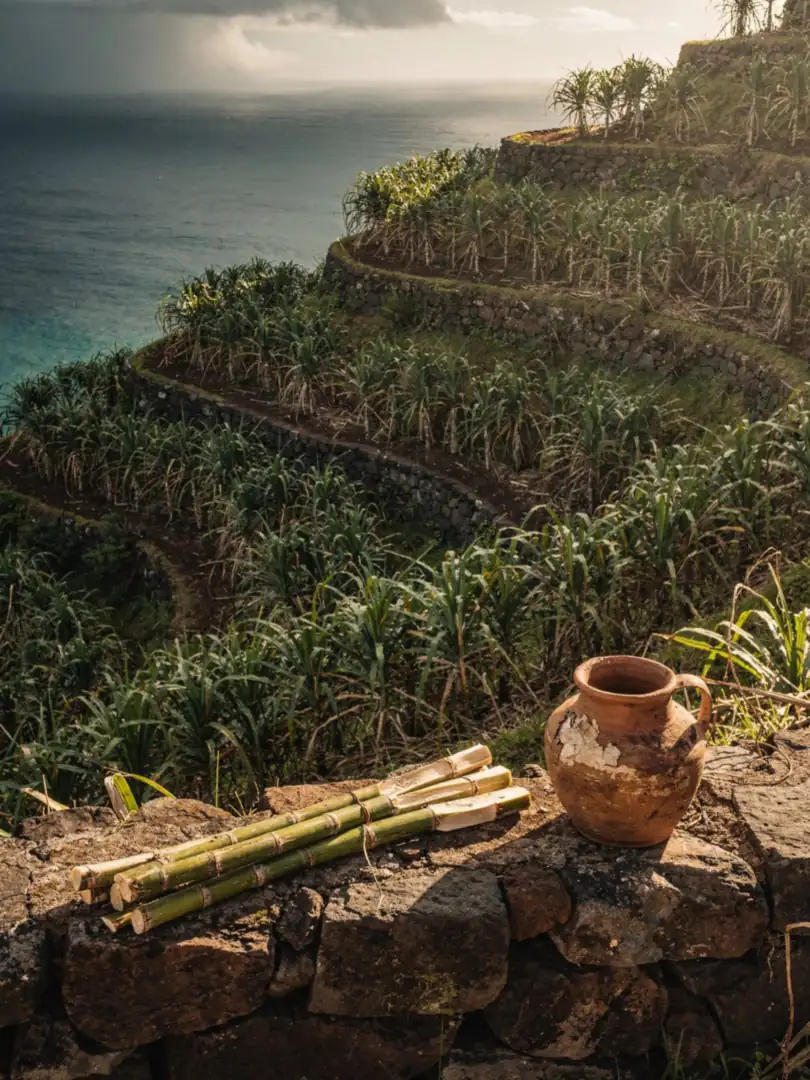
The history of rum begins long before the first rum was made—namely, with a plant. Sugarcane was domesticated in New Guinea, meaning it was transformed from a wild plant into a cultivated crop, and spread from there to South and Southeast Asia. In India, people learned to boil the juice down into solid sugar. Via Persia and the Arab world, the cane reached the Mediterranean, including Sicily. Traces of this journey survive in the English word "sugar," which comes through Arabic "sukkar" from the Old Indian "śarkarā."
There's no record of exactly when fermented sugarcane juice was first distilled. What is certain is that distillation existed early in Asia under the collective name Arrak. This covered very different raw materials, from palm sap to rice to sugarcane. Such an arrack isn't a direct ancestor in a straight line. But it shows that the idea of turning sugar into alcohol and then into a spirit wasn't a Caribbean invention.
Madeira and Brazil: Sugarcane Spirits Before Rum
The Portuguese took the decisive step westward. Around 1425, under Henry the Navigator, they brought cane cuttings from Sicily to Madeira. By the 15th century, the island had become one of Europe's major sugar suppliers, and the juice was also distilled into brandy there. Enslaved people already worked the sugar fields of these Atlantic islands—a pattern that would later repeat on a far greater scale in the Americas.
Columbus brought sugarcane to the Caribbean on his second voyage in 1493, and by around 1520 the first commercial sugar production was underway there. In Brazil, folklorist Luís da Câmara Cascudo dates the first cachaça to around 1532 in São Vicente. However, the Oxford Companion to Spirits calls the written evidence for this weak and confused. So anyone claiming cachaça is definitely older than rum is relying on tradition, not documentation.
Why Is Barbados Considered the Birthplace of Rum?
Barbados was settled by the English starting in 1627. In the 1640s, planters switched from tobacco and cotton to sugar, adopting knowledge from Brazil's sugar-producing regions. Boiling sugar produces molasses, a dark syrup from which no more sugar can be crystallized. There was also the foam skimmed from the boiling coppers. Both could be fermented and distilled instead of thrown away.
By around 1650, this waste product had become a trade good sold beyond the island, and it had its own name: rum. This is what sets it apart from the older spirits. Barbados didn't invent distilling from sugarcane, but it was there that molasses first became a drink produced for export on a large scale. The Mount Gay distillery traces its history to a 1703 document and markets itself as the oldest existing rum brand. That claim comes from the producer itself.
There are concrete reasons why rum became a commodity here of all places. Barbados is small, its forests were quickly cleared to fuel the sugar coppers, and both timber and food had to be imported. Planters needed something to trade for supplies from New England and Europe. A durable, strong spirit made from a byproduct was ideal for this. It could be shipped in barrels and quickly became a standard currency aboard ships and in other colonies.
Molasses or Juice: What Origin Reveals About Rum
History explains a distinction that still shapes flavor today. Rum from Barbados and most British and Spanish colonies was made from molasses, since it was a byproduct of sugar factories. Cachaça in Brazil and the later Rhum agricole of the French islands, by contrast, are distilled from fresh sugarcane juice. Juice-based spirits taste grassier and fresher, while molasses rum leans toward caramel, dried fruit, and spice.
This gives a simple answer to the question of where rum comes from. Sugarcane spirits have existed in many places for centuries. What became known as rum was the sugarcane spirit of 17th-century Barbados. Legally, rum is precisely defined today in the EU: a distillate made from molasses, cane sugar syrup, or sugarcane juice. Cachaça, on the other hand, is its own designation, reserved for Brazil, even though its raw material is the same as that of Rhum agricole.