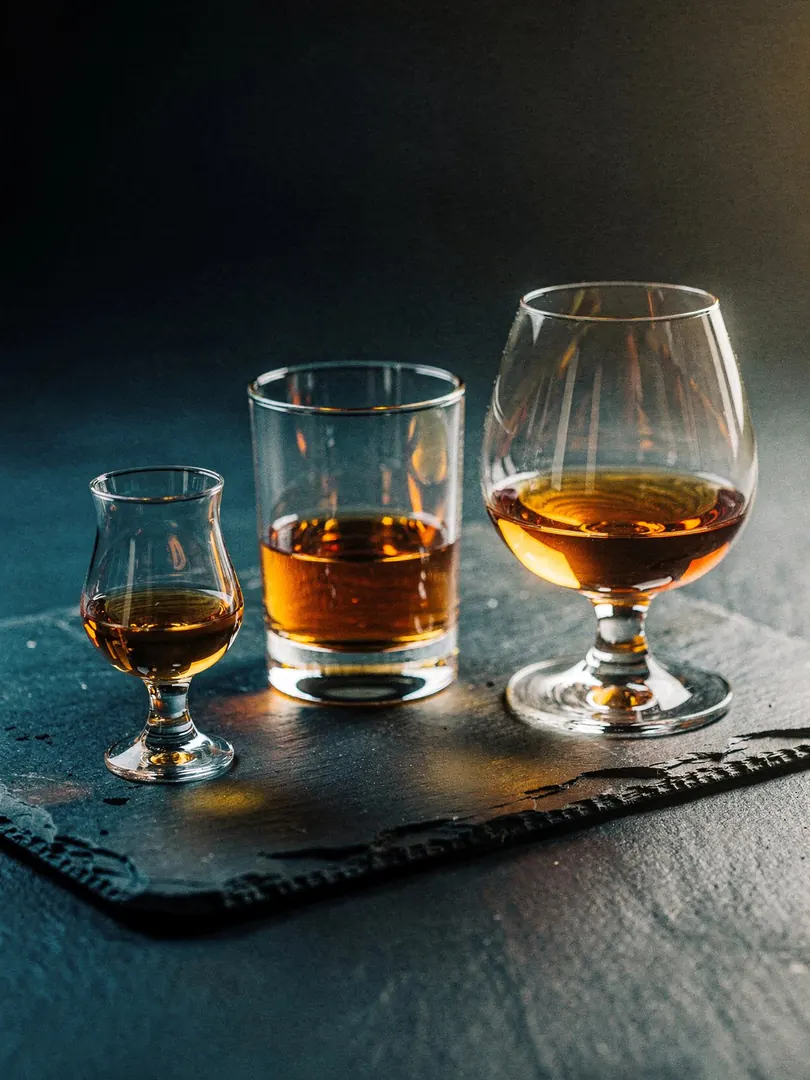
Glass and degrees
Which Glass and Temperature for Rum?
A tulip-shaped nosing glass works best for tasting rum: bulbous at the bottom, narrowing toward the top, so the aromas concentrate and the alcohol doesn't sting the nose. For neat tasting, rum is best served at room temperature, around 18 to 20 degrees Celsius (64 to 68°F), without warming the glass with your hand.
Which Glass for Rum? Tulip Shape Instead of Tumbler
A nosing glass, essentially a smelling glass, has a round bowl and a narrow opening. When you swirl it, the rum spreads over a large surface inside the bowl, releasing aromatic compounds that rise and concentrate at the top. The best-known shape is the copita from Andalusia, originally designed for sherry, alongside the short tulip glasses from the whisky world.
The tumbler, the heavy, straight-sided glass found behind bars, is built for mixed drinks. Its wide opening lets aromas and alcohol escape quickly. The rum seems milder in it, but also flatter, since the nose picks up less. For relaxing on the sofa, that's perfectly fine, but not for tasting and comparing.
The fill level matters too. A nosing glass should be filled no higher than the widest point of the bowl, usually around two centiliters (roughly two-thirds of an ounce) is enough. This leaves enough space above for the aromas to gather. A glass filled to the brim can neither be swirled properly nor smelled effectively, and your nose ends up right above the liquid, where the alcohol rises most intensely. A short stem has another advantage: you can hold the glass without warming the bowl with your hand.
A white wine glass makes a decent substitute. It also has a bowl shape and a slightly narrowed opening. What matters with any glass is that it's thin-walled and colorless, so you can see the color clearly and the glass doesn't become unnecessarily cold or warm.
Why the Large Cognac Snifter Falls Short
The classic snifter with its huge bowl and short stem looks elegant, but it's actually not ideal for rum. The large surface area lets a lot of alcohol evaporate, which then collects in the wide glass. Anyone who smells it gets hit first with a wave of ethanol that masks the delicate fruit notes.
Then there's the way it's held. The snifter is cradled in the palm so body heat warms the drink. This was once considered an art, some even used to warm cognac over a candle. For rum, this is unnecessary. At warmer temperatures alcohol evaporates faster, increasing the burn rather than releasing more aroma.
Which Temperature for Rum? The 18 to 20 Degrees in Detail
Room temperature is a good starting point for rum, meaning roughly 18 to 20 degrees Celsius (64 to 68°F). In this range, aromatic compounds are volatile enough to express themselves, while the alcohol doesn't overwhelm the nose. A rum straight from a cold cellar shelf needs a few minutes in the glass before it opens up.
Cold slows the evaporation of aromatic compounds, so the rum smells quieter. At the same time, sweetness is perceived less strongly at lower temperatures. That's why heavily sweetened rums often taste rounder when chilled, and why a chilled rum reveals little about its true balance. For comparison tastings, all samples should be at the same temperature.
Very warm rooms are the other extreme. In the height of summer at 28 degrees Celsius (82°F), every rum seems more alcoholic. Here it helps to hold the glass only by the stem or foot and pour small amounts that can be tasted quickly. A glass that's sat in the sun for an hour will skew any judgment.
Preparing Glasses: Dish Soap and Cupboard Odors
A clean glass matters more than the most expensive shape. Dish soap residue and odors from storage, say from cardboard or wood, settle as a film on the glass and mix with the rum. Rinse tasting glasses with hot water afterward and let them dry upside down on a clean cloth.
Before pouring, it's worth giving the empty glass a quick sniff test. If it smells of nothing, it's ready. Some people rinse the glass first with a splash of the rum they're about to pour, then discard it. You can do this, but it's not necessary with a clean glass. For comparisons, the rule is: use identical glasses for all samples, otherwise you end up comparing the glasses rather than the rum.