Harvest and mill
Sugar cane harvest: when and how is it harvested?
Sugar cane is harvested in the dry season, when the stalks hold the most sugar. This harvest period is called the campagne: on Martinique, the AOC sets it from January 1 to August 31, while on Madeira it lasts only a few weeks in spring. Cutting is done by hand or with harvesting machines, and the cane must then reach the mill quickly.
When is sugar cane ready for harvest?
A freshly planted field usually needs one to one and a half years before its first harvest. After that, the rootstock sprouts again, and the regrowth, known among experts as ratoon cane, can be cut again each year. With every cycle, yield drops a little, until the field is eventually replanted.
The cane is ripe when growth slows. This happens during the drier, often cooler season. The plant then stops producing new leaves and stores sugar in the stalk instead. That's why harvest falls almost everywhere within the dry season. In the Caribbean, that's roughly the first half of the year; on Madeira, it's spring; in the Southern Hemisphere, the months around winter there. Rain during harvest dilutes the juice and makes fields hard to work, for both machines and people.
The campagne: harvest and distilling season in step
The period when sugar factories and juice distilleries run is called the campagne. For rhum agricole, it is strictly regulated. The AOC Rhum de la Martinique allows harvesting from January 1 to August 31 and distilling from January 2 to September 5. Yield may not exceed 120 tons of cane per hectare, ripening agents are banned, and irrigation is only permitted within the first six months after cutting.
Madeira has an even shorter season. There, the cane is usually cut between late March and May, often for only a few weeks, and by hand on the terraces. Anyone making rum from fresh juice, then, only distills for part of the year. A distillery working with molasses, by contrast, can operate year-round, since molasses can be stored in tanks.
Machete or harvester: how is sugar cane cut?
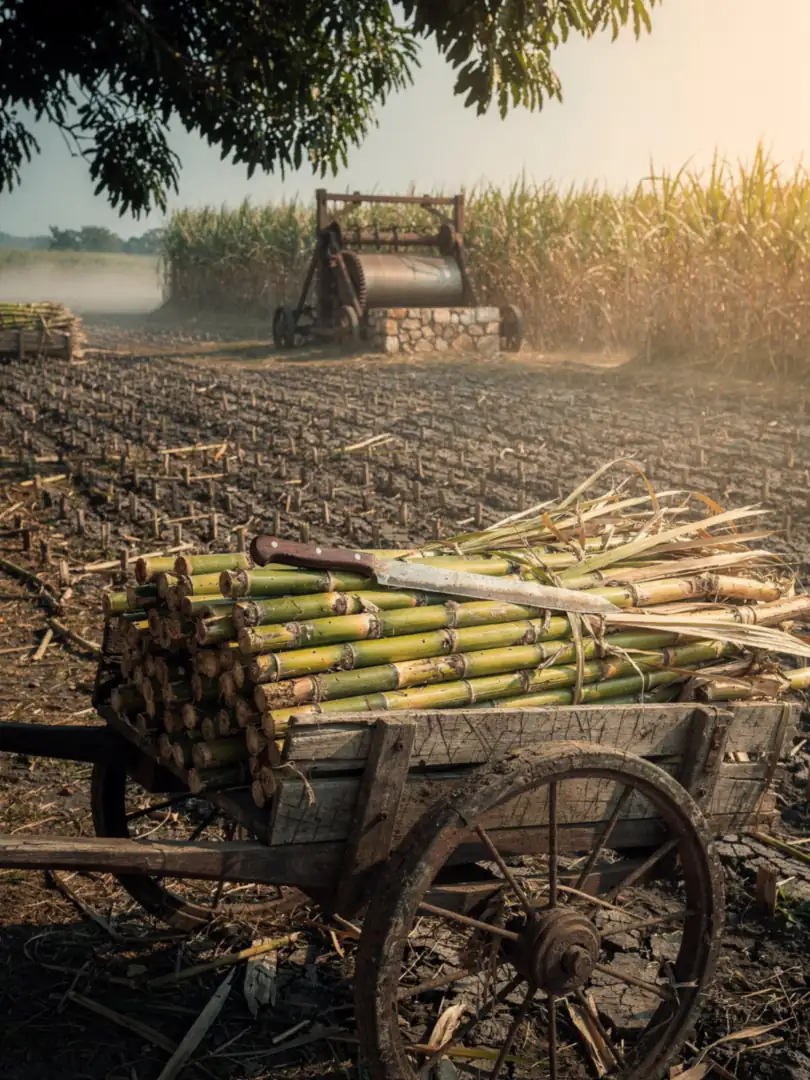
For a long time, harvesting was purely manual work done with a machete. Cutters sever the stalk close to the ground, where most of the sugar sits, and strip off the leaves and the sugar-poor tip. On steep slopes, small plots, and Madeira's terraces, this is still how it's done today. In flat growing regions, harvesting machines cut the cane, chop it into short pieces, and blow away the leaves.
Before manual harvesting, fields were often burned. The fire removes dry leaves and drives off snakes, but it places a heavy burden on the air. In the Brazilian state of São Paulo, a 2002 law set a phase-out timeline, and a voluntary 2007 agreement moved up the deadlines: by 2014, burning was to end on mechanically harvestable land, and by 2017 on the rest. Since then, machines harvest the green cane almost everywhere there.
From field to mill: why speed matters
Cutting starts a race against time. In the severed stalk, enzymes and microbes break down the sucrose, and the juice turns acidic and loses sugar. For rum made from fresh juice, the cane must therefore be pressed within a few hours, at most a few days. Juice-based rum can only be made, then, where the cane grows, and only during the campagne.
In the mill, heavy rollers squeeze the juice from the stalks. On Martinique, the AOC requires horizontal roller mills and cold pressing; the juice is clarified only mechanically, without heating and without lime. It must reach at least 14 degrees Brix, a measure of dissolved sugar. On Grenada, at River Antoine, a waterwheel still powers the cane mill today. What remains after pressing, the fibrous bagasse, usually ends up as fuel for the boilers.