From the sugar factory
How is molasses made? The sugar factory explained
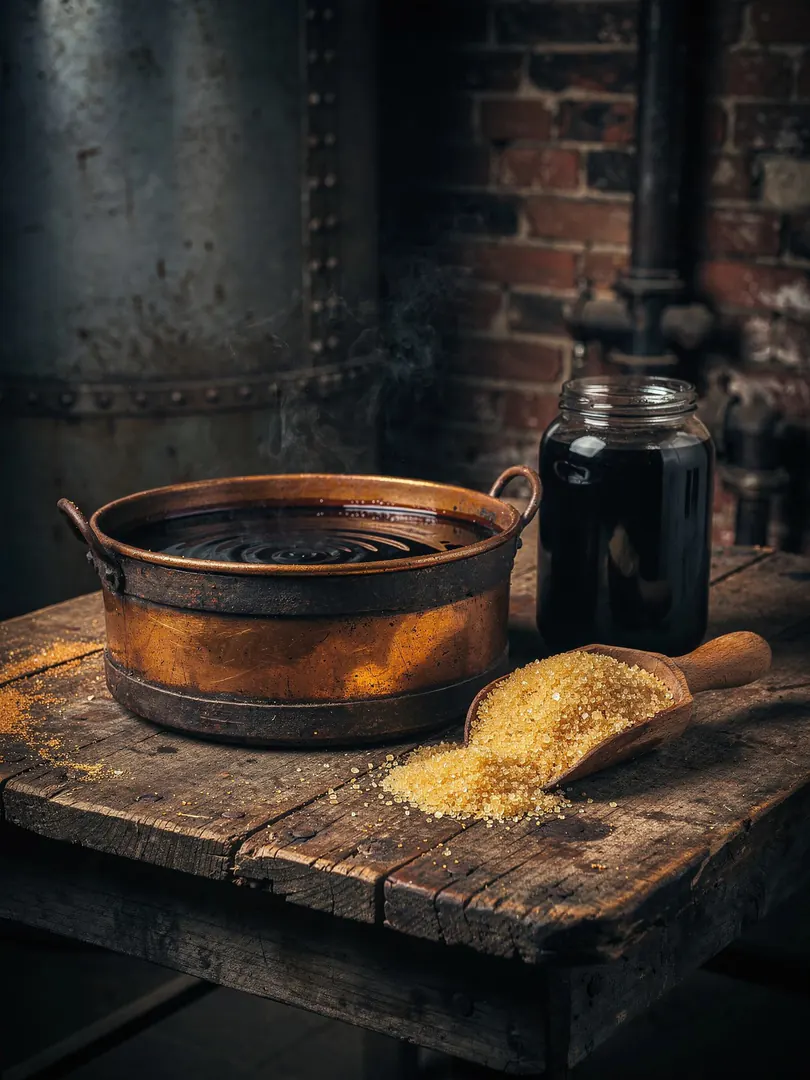
Molasses is made in the sugar factory: cane juice is boiled down until sugar crystallizes out, and centrifuges spin off the crystals. What remains is a dark syrup. After several passes, what's left is final molasses, also called C-molasses, from which most of the world's rum is distilled.
How does sugar cane become sugar?
A raw sugar factory runs around the clock during the campagne. First, roller mills press the juice from the cane. This raw juice is cloudy, full of dirt, fiber, and protein. At the factory, it's heated and treated with lime so the suspended particles settle out. This exact step is forbidden under the AOC Martinique for rhum agricole. There, the juice may only be clarified mechanically, without heat and without lime.
After that, the factory evaporates water in several stages until the thin juice becomes a thick syrup. It's then further concentrated in large vacuum pans, where sugar crystals grow. The vacuum lowers the boiling point so the sugar doesn't burn. The result is a mixture of crystals and viscous liquid known as massecuite. The sugar now has to be extracted from this mixture.
A-, B-, and C-molasses: what do the letters mean?
The massecuite goes into centrifuges. They spin so fast that the liquid is flung through a fine screen while the crystals stay behind. The first pass yields A-sugar and a syrup, A-molasses. Since it still contains plenty of sugar, the factory boils it again. The second pass yields B-sugar and B-molasses, and a third often yields C-sugar and C-molasses.
With each pass, the syrup becomes darker, thicker, and poorer in sugar that can still be crystallized out. At some point, another attempt isn't worth it. What remains is called final molasses, blackstrap in English, miel final in Spanish. The specification for Cuban rum names it explicitly: predominantly miel final is used, also called melaza or miel C. B-molasses is not banned, either on its own or blended in. Experts refer to heavily depleted molasses as exhausted molasses; it contains less sugar and more minerals.
What's in molasses?
Despite all these boiling rounds, molasses stays sweet. Comparison tables that Cuba attaches to its rum specification show a dry matter content of over 80 degrees Brix, more than half of which is sugar. Part of it is sucrose that simply wouldn't crystallize anymore, another part is glucose and fructose formed from sucrose during cooking. Yeasts can ferment most of these sugars, but not a small remainder.
Added to this are minerals like potassium, nitrogen and phosphorus, which serve as food for the yeast, along with dark pigments and roasted compounds from the long cooking process, plus acids. Cuba emphasizes in its specification that its own molasses contains hardly any sulfur compounds, which could smell unpleasant during distillation. That's a claim from the applicant. But it shows what master distillers pay attention to: molasses isn't a uniform raw material, it differs by factory, cane and vintage.
Why molasses turned rum into a tradeable commodity
Fresh cane juice spoils within a short time, whereas molasses keeps for months in tanks and on ships. This means a distillery can buy molasses, store it, and process it all year round without running its own sugar mill. Many do exactly that. This is how rum went from being a plantation byproduct to a commodity that could be produced far from the field.
Legally, the boundary is clear. The EU permits molasses or syrup from cane sugar production, as well as sugarcane juice, for rum. Beet molasses from European sugar factories looks similar, but a spirit made from it isn't rum. The type of molasses also leaves its mark: on Martinique, the g.i. Rhum de sucrerie de la Baie du Galion ferments molasses mixed with more exhausted molasses in open wooden vats for its Grand arôme.