The short answer
Calories and sugar vary widely in alcohol-free wine. Check the nutritional information per 100 milliliters and calculate it for your glass. Neither "alcohol-free" nor "0.0" means sugar-free. Nor does it mean calorie-free.
Why a blanket calorie count doesn't help
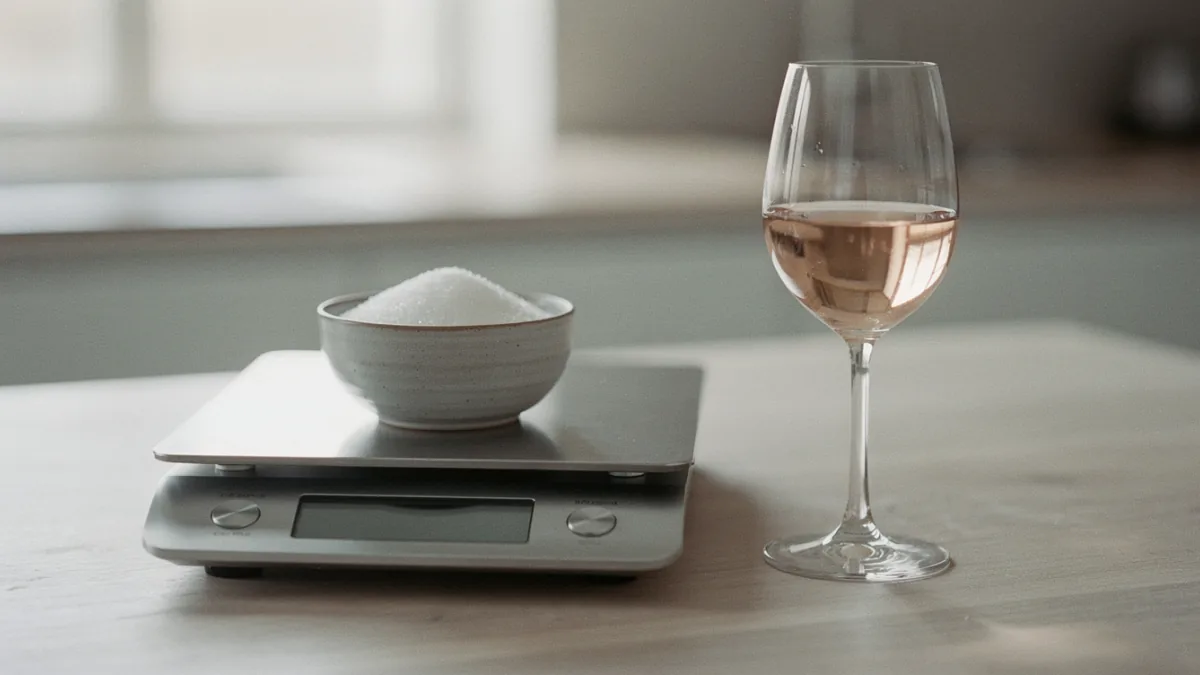
Alcohol provides energy. When the producer removes it, this source largely disappears. But how much energy ends up in the glass also depends on the rest of the composition. Often the energy content is lower than that of the alcoholic version. This doesn't add up to a uniform value for all bottles.
For your shopping, what counts is the nutrition table on the bottle you're holding. It's more precise than a marketing phrase like "fewer calories." Fewer than what? The table answers that. It also shows what quantity the figure refers to.
Three concrete product examples
Just these three bottles vary widely: 6 to 23 kcal per 100 milliliters. This is exactly why it's worth checking the table on your own bottle. This selection isn't representative of the whole market, and it's certainly not a taste assessment. The figures come from the manufacturer documents named above, checked on September 18, 2026. If a recipe changes, the figure on your bottle is what counts.
| Product | Energy per 100 ml | Sugar per 100 ml |
|---|---|---|
| Carl Jung Cuvée Dry | 6 kcal | approx. 0.5 g |
| Kolonne Null Sauvignon Blanc | 13 kcal | 2,6 g |
| Carl Jung Merlot | 23 kcal | approx. 4.0 g |
How to calculate a glass
A glass holds more than 100 milliliters, so a quick conversion is worthwhile. For 150 milliliters, multiply the value per 100 milliliters by 1.5. For 200 milliliters, use the factor 2. Use the same portion size for both energy and sugar. Otherwise you might accidentally compare two differently sized glasses.
A worked example: 13 kcal and 2.6 grams of sugar per 100 milliliters. For a glass of 150 milliliters, that comes to 19.5 kcal and 3.9 grams of sugar. These figures are calculated from the manufacturer's data. There's no independent lab analysis behind them.
You don't have to estimate the portion. Measure your usual glass with water once, and you'll know the amount for good. A 750-milliliter bottle holds five 150-milliliter portions. This also makes it easier to plan quantities for guests.
Tasting sweet and containing sugar are two different things
The sugar figure is a measured number. Whether the drink tastes sweet to you is decided by your palate. The two are related but not the same: acidity can make sweetness less noticeable. So compare the numbers first, then the taste. A lower number is a sensible reason to choose a product if you want less sugar. It isn't a general judgment of quality.
Don't rely solely on words like "fruity," "light," or "dry" in the sales copy. Look in the nutrition table for the line "of which sugars." Check the reference quantity as you do. Don't assume values per 100 grams or per glass are the same as values per 100 milliliters without checking.
Does that make alcohol-free wine healthy?
A lower calorie count initially just describes the energy content. It isn't a verdict on health. For a mindful choice, it's better to look at three figures separately: alcohol, sugar, and portion size. A single favorable figure doesn't add up to a health claim.
If you're simply looking for a calorie-free drink to quench your thirst, you don't need a wine alternative for that. It's better to choose alcohol-free wine based on taste and occasion. If you have specific dietary requirements, what matters is the composition of the actual product. That's on the bottle, not in the marketing copy.