The short answer
A wine cooler keeps wine consistently cool and dark for months or years. For pure storage, a single zone set to around 10 to 12 °C is enough. Multiple zones only pay off if you also want to keep wines ready at serving temperature. Before buying, what matters most is the cooling technology, the noise level according to the energy label, a door that blocks light, and a location that matches the unit's climate class.
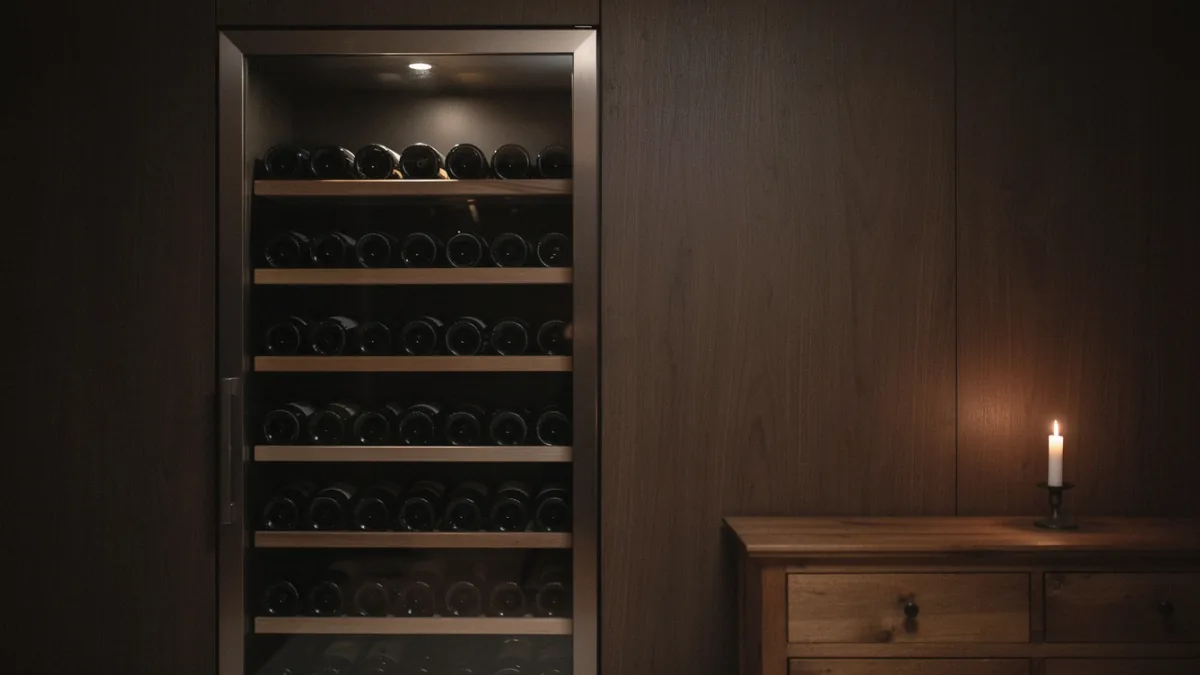
What is a wine cooler, and what can it do better than a refrigerator?
The EU describes a wine storage appliance as a special cooling device for wine. It regulates temperature precisely, has a target temperature of 12 °C for the wine storage compartment, and includes measures against vibration. According to the German Federal Environment Agency, such an appliance is intended solely for storing and tempering wine bottles, within a range of about 5 to 20 °C.
A regular refrigerator serves a different purpose. Consumer advice centers recommend 7 °C in the top compartment there, so food stays fresh. For wine, that's colder than necessary, since the German Wine Institute cites an average of 10 to 12 °C for storage. A few days in the fridge won't hurt. But it's not built for long-term storage.
The terminology used in stores isn't consistent. "Wine refrigerator" often serves as a general term. "Wine cooler" usually refers to a device for storage, while "wine climate cabinet" refers to one with multiple zones for different serving temperatures. A beverage cooler simply keeps bottles cold and isn't designed for long-term storage. So pay less attention to the name and more to the specifications on the data sheet.
Single-zone or dual-zone wine cooler?
First, think about what you need the cooler for. If you want to keep bottles for years, a single zone with a consistent temperature is enough. That's exactly what a single-zone unit is made for, and it's quick to set up.
Two or more zones help if you want to keep wines ready to drink. Then, for example, white wine might sit cooler on top and red wine a bit warmer below. The table shows the reference values from the German Wine Institute. These apply to serving, not storage.
If you're also storing wine long-term in a multi-zone unit, set one zone to the storage value and use only the others for serving. That's because the drinking temperature for red wine is significantly higher than the 10 to 12 °C the Wine Institute recommends for storage.
| Wine type | Serving temperature according to the German Wine Institute |
|---|---|
| white sparkling wine and rosé sparkling wine | 6 to 8 °C |
| young, light white wines, such as Riesling Kabinett | 9 to 11 °C |
| rosé wines, such as Weißherbst | 9 to 13 °C |
| mature, full-bodied white wines, such as Weißburgunder Spätlese | 11 to 13 °C |
| young, light red wines, such as Portugieser or Trollinger | 14 to 16 °C |
| mature, rich red wines, such as Spätburgunder Spätlese | 16 to 18 °C |
| tannin-heavy red wines from barrique aging | 18 to 20 °C |
Compressor, thermoelectric, or absorption: which cooling technology is right for you?
A compressor works like the one in a household refrigerator. The independent energy consultancy Topten calls this principle very energy-efficient, though the compressor does make noise. It also produces enough cold in warm rooms. An ADAC guide on cooler boxes states that compressor units can achieve up to 50 degrees of difference from the ambient temperature.
Thermoelectric units cool with a Peltier element and don't need a compressor. According to Topten, their energy efficiency depends on the ambient temperature. The same ADAC guide notes that this technology only manages 15 to 20 degrees below ambient. So in a warm room during a heat wave, such a unit quickly reaches its limits. A fan is often still audible.
Absorption units also work without a compressor and are, according to Topten, silent but not very energy-efficient. You'll know them from hotel minibars. Since a wine cooler runs around the clock, it's especially worth checking the annual energy consumption here.
| Cooling technology | Noise | Energy efficiency | Weak point |
|---|---|---|---|
| Compressor | audible | very high | noise |
| Thermoelectric | quiet, fan often audible | depends on room temperature | warm rooms |
| Absorption | lautlos | gering | power consumption |
How quiet is a wine cooler? Noise and vibration
You don't have to guess the noise level. Since 2021, the energy label for wine storage appliances shows the noise emission in dB(A) along with a noise class. According to EU regulation, a cooling appliance without a compressor is considered low-noise if it's below 27 dB(A). If the cooler will be in your living room or bedroom, this figure matters more than almost any other spec.
When it comes to vibration, a sober look is worthwhile. The EU requires measures against vibration for wine storage appliances. However, the Australian Wine Research Institute (AWRI) found no studies showing that compressor vibrations harm wine. Still, a unit that stands level and doesn't rattle is more pleasant.
UV protection: glass door or solid door?
Light really can spoil wine. The AWRI describes what's known as light strike: under light, sulfur compounds form that smell like cooked cabbage or wet wool. In one test under fluorescent tubes at a distance of 35 cm, white wine in clear glass showed the defect after just 3.3 hours, while wine in green glass took 31.1 hours.
According to the AWRI, direct sunlight is even more damaging than lamp light. A glass door looks nice, but it should be made of UV-protective glass, and the cooler shouldn't be placed in direct sun. Only switch on the interior light when you're searching for something. If you store many white wines in clear bottles, a solid door is the safer choice.
Humidity in a wine cooler
The EU definition of a wine storage compartment specifies a humidity level of 50 to 80 percent. The reason is natural cork. The German Wine Institute recommends storing corked bottles lying down for long-term storage, so the cork doesn't dry out. Very dry air over a long period works against this goal.
How a unit maintains humidity varies from model to model. Ask about this when buying, and check the value later with a hygrometer. For screw caps, humidity doesn't matter for the closure. However, according to the wine magazine Vinum, labels and cardboard boxes can develop mold in high humidity with stagnant air.
Capacity: how many bottles actually fit?
The energy label states the number of standard wine bottles the unit can hold. This figure refers to a standard bottle. Bulging Burgundy bottles, thick-glass sparkling wine bottles, and magnums need more space. If bottles have to stand upright, you often lose an entire shelf.
So calculate based on your actual collection and plan for some extra room. Count how many bottles you have today and how many you'll add each year. If a few shelves remain empty after loading up, you won't end up with boxes stacked in the hallway after your next wine purchase.
Energy label: what the class tells you about a wine cooler
Since 2021, wine storage appliances carry the new energy label with classes A through G, regulated under EU Regulation 2019/2016. When it was introduced, the German Federal Environment Agency pointed out that the top class, A, usually remains unfilled at first. So don't be put off right away by a mid-range class.
More telling is the annual energy consumption in kilowatt-hours, which is also shown on the label. Compare it between units with a similar bottle capacity. The QR code on the label takes you to the European product database with the full data sheet.
Built-in or freestanding: finding the right spot
Every cooling appliance has a climate class. It indicates the room temperature at which it works reliably. If you want to place the cooler in a cool cellar or in the garage, check this spec before buying. The ranges are set out in the EU regulation.
A built-in unit is designed for a kitchen niche and draws air through the openings provided for that purpose. You shouldn't simply push a freestanding unit into a cabinet, since it needs to dissipate its heat. The installation instructions specify how much clearance it needs. Consumer advice centers generally recommend placing cooling appliances in a cool spot away from sun, stove, and heating.
| Climate class | Room temperature according to EU regulation |
|---|---|
| SN (extended temperate) | 10 to 32 °C |
| N (temperate) | 16 to 32 °C |
| ST (subtropical) | 16 to 38 °C |
| T (tropical) | 16 to 43 °C |
Managing your wine cooler and cellar in Gustofolio
In Gustofolio, you can set up storage locations right down to the individual slot, meaning cellar, rack, row, and slot. A wine cooler thus becomes its own storage location, and you can see exactly which bottle is in which slot. If you rearrange things, the history of the moves stays on record.
If a sensor is connected via Home Assistant, Gustofolio displays temperature and humidity for each storage location. You set a target range and can see how long a value has been out of range. For each wine, the app also shows drinking maturity and serving temperature.
Frequently asked questions about wine coolers
Quick answers to questions that often remain unanswered before buying.
What temperature should I set in a wine cooler?
For storage, 10 to 12 °C is a good value, as recommended by the German Wine Institute. The EU definition of a wine storage compartment assumes 12 °C. More important than the exact degree is that the temperature stays consistent.
Can I store wine in a regular refrigerator?
For a few days, yes. But with the recommended 7 °C, a refrigerator is colder than proper wine storage, and it's opened constantly. For bottles meant to be kept for months or years, a wine cooler is the better choice.
Can a wine cooler go in the garage?
Only if the temperature there matches the climate class. Even class SN is only rated from 10 °C room temperature upward. In a garage that gets colder in winter, the unit would be operating outside its range. For hot summers, a class with a higher upper limit, like ST or T, is the safer choice.
Do bottles in a wine cooler need to lie down?
Bottles with natural cork meant for long-term storage should be laid on their side so the cork doesn't dry out. According to the German Wine Institute, wines with corks that you'll drink soon can also stand upright for 1 to 2 years without issue. Screw caps aren't affected by this at all.